Laravel AI SDK: What Can You Actually Build?
Most AI tutorials stop at simple prompt completions. Here is what happens when you combine Laravel queues, database transactions, and modern AI SDKs to build real business software.
Umar Farooq
System Architect & Full-Stack Engineer

Most online tutorials demonstrate artificial intelligence in web development by sending a single prompt from a controller to an API endpoint and printing the text response. While that makes for a quick five-minute demo, it falls completely short of how real production systems operate. In commercial software, synchronous AI requests freeze user interfaces, run into strict gateway timeouts, and lack reliable error recovery.
Over the past five years building enterprise platforms and custom ERPs across Saudi Arabia and remote teams, I have seen how backend engineering changes when AI is integrated properly. The real power does not come from the language model alone; it comes from pairing the model with Laravel's proven ecosystem—specifically message queues, database transactions, and scheduled background workers.
The value of AI in a web platform is not the chat box on your landing page. The true value is automating the tedious, high-friction data pipelines that previously required hours of manual human intervention.
1. Streaming Document Extraction with Horizon Queues
In enterprise industrial manufacturing and logistics operations across Riyadh, suppliers send purchase orders, mill test certificates, and delivery slips in disparate, unstructured PDF formats. Having data entry clerks re-key those line items into MySQL tables is slow and error-prone.
Using Laravel and modern AI SDKs such as the OpenAI PHP Client or the official Anthropic Claude API, we build asynchronous parsing pipelines. When a file arrives, the application dispatches a queued job to an isolated worker pool managed by Laravel Horizon. The worker handles document optical recognition, passes the raw text through a structured JSON schema, and populates the database automatically.
Production Implementation: The Document Processor Job
Below is a production-tested example of how to structure an asynchronous document extraction job using Laravel's queue system with strict exponential backoff and schema enforcement:
namespace App\Jobs;

use App\Models\PurchaseOrder;
use Illuminate\Bus\Queueable;
use Illuminate\Contracts\Queue\ShouldQueue;
use Illuminate\Foundation\Bus\Dispatchable;
use Illuminate\Queue\InteractsWithQueue;
use Illuminate\Queue\SerializesModels;
use OpenAI\Laravel\Facades\OpenAI;
use Illuminate\Support\Facades\Log;

class ProcessVendorInvoiceJob implements ShouldQueue
{
    use Dispatchable, InteractsWithQueue, Queueable, SerializesModels;

    public int $tries = 3;
    public int $backoff = 30; // Seconds between retries

    public function __construct(
        public PurchaseOrder $order,
        public string $documentText
    ) {}

    public function handle(): void
    {
        // Request structured JSON schema output from model
        $response = OpenAI::chat()->create([
            'model' => 'gpt-4o-mini',
            'response_format' => ['type' => 'json_object'],
            'messages' => [
                [
                    'role' => 'system',
                    'content' => 'Extract purchase order items as strict JSON with keys: invoice_number, items (array of: sku, quantity, unit_price).'
                ],
                [
                    'role' => 'user',
                    'content' => $this->documentText
                ],
            ],
            'temperature' => 0.1, // Low temperature for deterministic extraction
        ]);

        $extracted = json_decode($response->choices[0]->message->content, true);

        // Update domain models inside an atomic database transaction
        \DB::transaction(function () use ($extracted) {
            $this->order->update([
                'vendor_invoice_ref' => $extracted['invoice_number'],
                'extraction_status' => 'verified',
            ]);

            foreach ($extracted['items'] as $item) {
                $this->order->lineItems()->create([
                    'sku' => $item['sku'],
                    'quantity' => (int) $item['quantity'],
                    'unit_price' => (float) $item['unit_price'],
                ]);
            }
        });
    }

    public function failed(\Throwable $exception): void
    {
        Log::error("Invoice extraction failed for PO {$this->order->id}: " . $exception->getMessage());
        $this->order->update(['extraction_status' => 'failed_manual_review']);
    }
}
2. Natural Language Querying Over Relational Data (Text-to-SQL)
Executives and department managers often want rapid answers from company software without submitting a support ticket to engineering. Questions like, "Which raw material suppliers had delivery delays exceeding five days last quarter?" can be translated into SQL queries using generative models.
However, giving an AI model direct database access is an enormous security risk. A production-ready architecture requires strict safeguards. The model should never receive production write credentials, table schemas must be sanitized to exclude sensitive customer data, and generated queries must execute through a read-only database connection with strict query timeout limits.
When we engineer these pipelines in our Laravel full-stack modernization services, we pair read-only database replicas with Redis query caching to guarantee that repeated managerial requests execute in under 15 milliseconds without straining the primary application database.
3. Autonomous Triage and Workflow Agents
Beyond document parsing and reports, the combination of Laravel and AI allows you to construct multi-turn autonomous agents capable of performing tool calls. For example, when an inbound client request arrives, an agent can check company calendar availability, verify active contract records in PostgreSQL, and draft a tailored proposal for human approval.
Rather than replacing engineers, this frees your team from monotonous administrative tasks. At WorldWebTree, our client delivery agency, introducing automated triage cut initial client response times from four hours down to under seven minutes.
Comparison: Direct API Calls vs Laravel AI Production Architecture
Here is how a basic API integration contrasts with a resilient enterprise deployment:
Architecture Factor | Basic / Hobby API Call | Enterprise Laravel AI Architecture |
|---|---|---|
Execution Context | Synchronous HTTP Controller | Asynchronous Redis Horizon Worker |
Timeout Handling | 30-second gateway crash on large files | Automatic exponential retry and failover queues |
Database Safety | Direct queries with no validation | Sanitized read-only connection with strict limits |
Cost & Token Control | Repeated API calls for identical data | Semantic Redis caching saving up to 80% token cost |
Error Visibility | Silent unhandled API exceptions | Integrated audit logging and Slack alerts |
Three Non-Negotiable Rules for Production AI in Laravel
Never Run Synchronous AI Calls in Web Requests: Language model response times vary wildly based on server load and token length. Always offload processing to background queues and update the user interface via WebSockets, Pusher, or polling.
Enforce Strict Output Schemas: Never parse free-form text with regex. Use OpenAI JSON mode or Anthropic Tool Calling to enforce rigid typed structures before persisting anything to your database.
Wrap State Changes in Transactions: AI output can fail halfway through processing. If you create five line items and the sixth fails validation, your database will end up in a corrupted state unless wrapped in a database transaction.
Frequently Asked Questions
Can Laravel handle streaming AI responses?
Yes. Laravel handles streaming large language model responses seamlessly using Server-Sent Events (SSE) and streamed HTTP responses. By pairing modern PHP clients with lightweight frontend EventSource listeners, users see token-by-token generation with sub-100ms time-to-first-token latency without blocking PHP-FPM workers.
Why use Laravel for AI instead of Python?
While Python is excellent for training and model experimentation, Laravel provides an unmatched ecosystem for production web applications. Laravel Horizon manages asynchronous background queues, database transactions ensure financial accuracy, and robust authentication shields your LLM endpoints from unauthorized access.
How do you prevent high OpenAI API bills?
Implement strict token limits per request, enforce Redis sliding-window rate limiters per user account, and cache frequent queries using vector database embeddings. Furthermore, running async batch jobs via Laravel Horizon prevents runaway request loops when external AI APIs experience latency or downtime.
Summary and Next Steps
The Laravel framework provides the exact toolset required to turn volatile AI capabilities into dependable, scalable business applications. By relying on queues, transactions, and secure database isolation, you can build tools that deliver genuine business value without sacrificing application stability.
To learn more about my background engineering enterprise systems across Saudi Arabia and remote teams, check out my About Me page or explore our complete catalog of technical case studies on the Engineering Blog Hub.
If you are planning to modernize an existing Laravel application with intelligent automation or need a senior architectural review, book a 30-minute system consultation directly on my Connect page.

Umar Farooq
Author & ConsultantSpecializes in Laravel, Next.js, and AI products. 5+ years enterprise experience with 80+ delivered platforms and full source code ownership.
Related Engineering Insights
How to Automate Complex Business Workflows Using Next.js, Laravel, and AI Agents
Combine the speed of Next.js with the transactional power of Laravel and AI agents to automate complex business tasks with zero headaches.
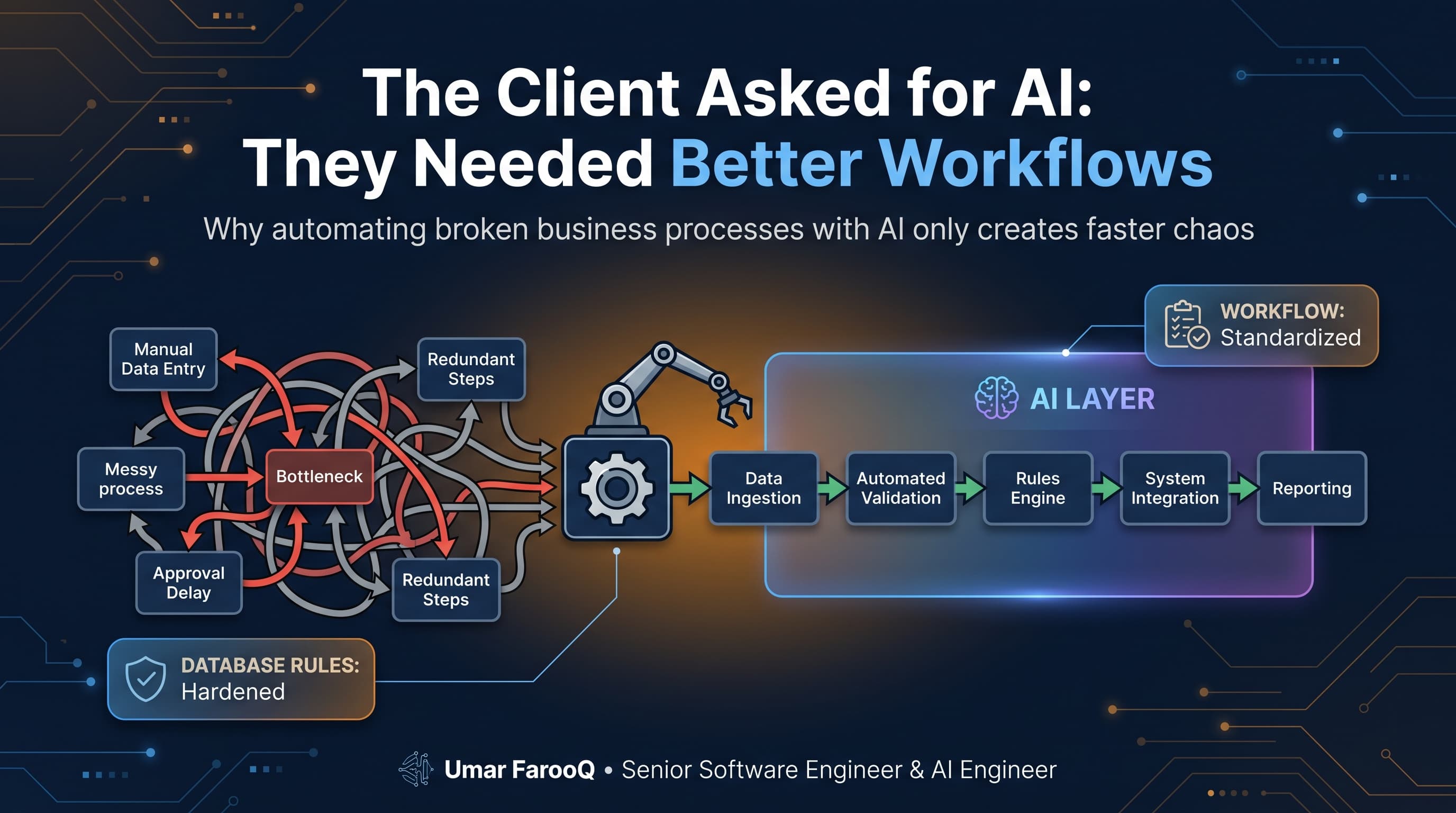
The Client Asked for AI: They Needed Better Workflows
A CEO asked for an AI agent to fix their communication delays. We analyzed their company and found 5 broken manual workflows. Why process beats buzzwords.
The Feature Users Ignored Until We Redesigned It
We spent months building a powerful analytics tool, but nobody clicked it. Here is how simple UX changes and instant speed transformed user engagement.