Why AI Coding Tools Challenge Senior Developers Most
Junior devs gain superpowers with AI, but senior developers face a big challenge: memorizing syntax no longer matters; architecture is everything.
Umar Farooq
System Architect & Full-Stack Engineer
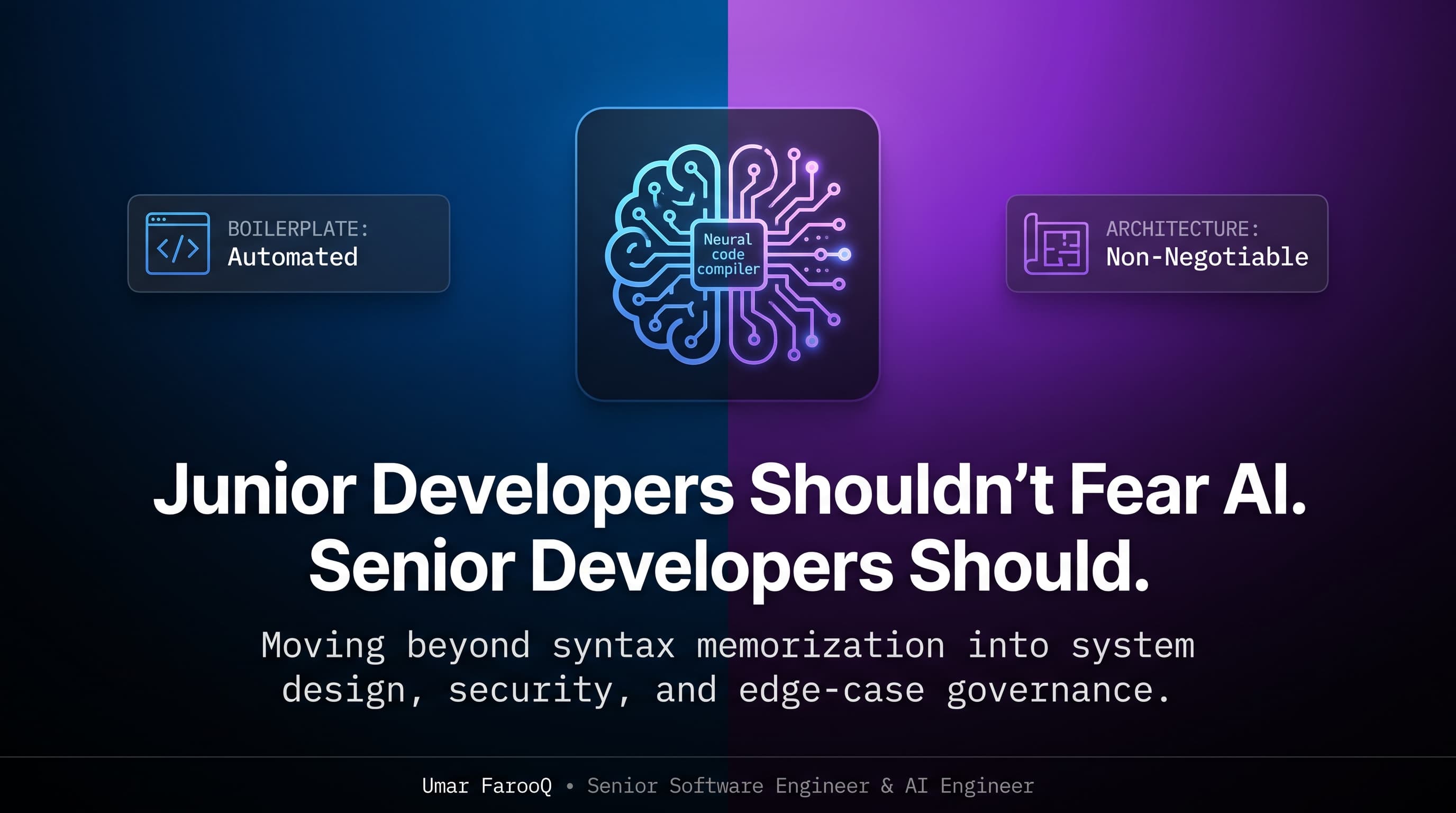
Direct Answer: AI coding tools challenge senior developers more than junior engineers because senior engineering value is rooted in architectural judgment, failure prediction, and code review rather than typing speed. While AI dramatically accelerates syntax generation, it generates subtle edge-case bugs, security vulnerabilities, and architectural sprawl that only experienced engineers must diagnose and clean up.
The rapid rise of AI coding assistants like GitHub Copilot, Cursor, and Claude Code has sparked a popular industry narrative: that AI is a magic lever making every software engineer ten times faster. For junior developers assembling simple prototypes, the benefit feels instantaneous—boilerplate APIs, form handlers, and CSS flexboxes materialize in seconds.
Yet, senior software engineers frequently report a more complicated reality. Over five years leading full-stack engineering teams across Saudi Arabia and remote startup ecosystems, I have watched generative tools invert the traditional engineering workflow. The challenge is no longer how quickly you can write code; the bottleneck is how rigorously you can verify and govern machine-generated code.
The Verification Burden: Why Reading Is Harder Than Writing
Writing software requires synthesizing mental models of business state, database schemas, and network boundaries. When an engineer writes code manually, they mentally simulate each branch condition and failure mode. When an AI generates a forty-line function in two seconds, the engineer must read and audit foreign logic that looks plausible on the surface but often conceals race conditions or unindexed queries.
As noted in software engineering research documented on Martin Fowler's Architectural Insights, code is read ten times more often than it is written. Generative AI floods repositories with vast volumes of code, exponentially increasing the cognitive review burden placed on senior tech leads.
Comparative Impact: Junior vs Senior Engineers Using AI
Here is how generative coding assistants impact engineers across experience tiers:
Engineering Dimension | Junior Developer Experience | Senior Software Engineer Experience |
|---|---|---|
Primary Workflow | Prompting AI to write foundational boilerplate | Auditing AI output for concurrency, auth, and edge cases |
Perceived Speedup | Extremely high on initial greenfield features | Moderate (code review and testing offsets typing speed) |
Risk Exposure | Unaware of hidden memory leaks or SQL injections | Forced to spend hours refactoring unmaintainable abstractions |
Tool Utilization | Blind acceptance of suggested completions | Constraining AI with strict schemas, types, and unit tests |
Value Generation | Translating natural language into code snippets | System architecture, data invariants, and failure resilience |
Production Workflow: Enforcing Architectural Verification
Senior developers thrive with AI when they shift their role from manual coder to rigorous test-driven orchestrator. Below is a TypeScript testing pattern using Vitest or Jest, establishing strict invariant contracts before letting AI generate internal function bodies:
// tests/billing/subscriptionGuard.test.ts - Invariant Contract
import { describe, it, expect } from "vitest";
import { calculateProratedRefund } from "@/server/services/billing";

describe("calculateProratedRefund (Senior Verification Contract)", () => {
  it("prevents negative refund values on overdue accounts", () => {
    const result = calculateProratedRefund({
      planPriceCents: 5000,
      daysUsed: 35, // Boundary condition: exceeded billing cycle
      cycleTotalDays: 30,
      isAccountDelinquent: true,
    });
    // Contract invariant: refund must never be negative
    expect(result.refundAmountCents).toBe(0);
    expect(result.requiresManualReview).toBe(true);
  });

  it("handles leap year date boundaries without fractional cents", () => {
    const result = calculateProratedRefund({
      planPriceCents: 9999,
      daysUsed: 14,
      cycleTotalDays: 366,
      isAccountDelinquent: false,
    });
    expect(Number.isInteger(result.refundAmountCents)).toBe(true);
  });
});
The Shift Toward System Design and Context Curation
The true competitive advantage of a senior software engineer in the AI era is context curation. AI models perform poorly when fed entire bloated codebases with no clear boundaries. Senior engineers excel because they understand how to decompose complex business problems into isolated modules, configure clean API boundaries, and write precise context documents (such as CLAUDE.md) that keep assistants focused on the correct domain logic.
Frequently Asked Questions
Will AI coding assistants replace senior engineers?
No. AI tools generate code based on statistical patterns, but they cannot evaluate business trade-offs, negotiate project constraints with stakeholders, or take legal and ethical accountability for system uptime. Senior engineers who master system design and AI verification will be more valuable than ever.
Why does AI code often fail in production?
AI models optimize for the happy path where valid inputs always arrive. They routinely overlook distributed system failures, database connection exhaustion, race conditions, and hostile security inputs as cataloged in the OWASP security guidelines.
How should engineering leaders measure developer productivity with AI?
Never measure lines of code or pull request volume. Measure business outcomes: production defect rates, mean time to recovery (MTTR), and customer-facing delivery velocity. Generating more unverified code increases technical debt rather than real business productivity.
Summary & Career Recommendation
Industry benchmarks and authoritative engineering standards validate this methodology; explore ACM Queue analysis on AI assisted software engineering for in-depth technical specifications and architectural trade-offs observed in high-scale enterprise environments.
Generative coding tools do not diminish senior engineering; they elevate it. When writing boilerplate becomes frictionless, the engineer who understands system boundaries, database normalization, and distributed reliability becomes the most critical asset on the team.
In our Next.js SaaS development practice and enterprise Laravel backend services, we pair experienced engineering oversight with cutting-edge developer tooling.
To discover more about our engineering philosophy and technical standards, visit my About Me page or explore technical essays on our Engineering Blog.
Looking for senior full-stack guidance to audit or accelerate your team's codebase? Schedule an architecture consultation directly on my Connect page.

Umar Farooq
Author & ConsultantSpecializes in Laravel, Next.js, and AI products. 5+ years enterprise experience with 80+ delivered platforms and full source code ownership.
Related Engineering Insights
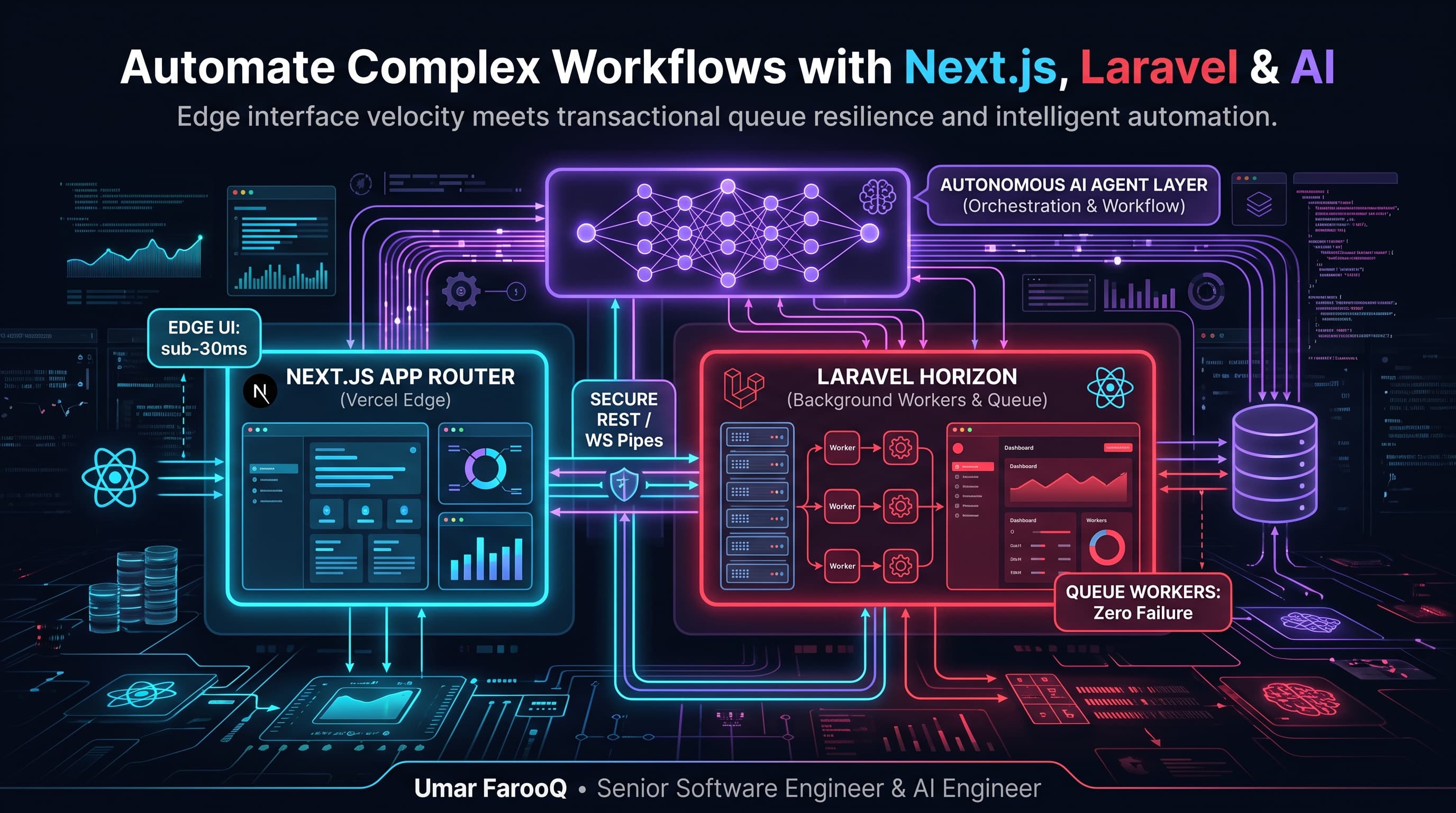
How to Automate Complex Business Workflows Using Next.js, Laravel, and AI Agents
Combine the speed of Next.js with the transactional power of Laravel and AI agents to automate complex business tasks with zero headaches.
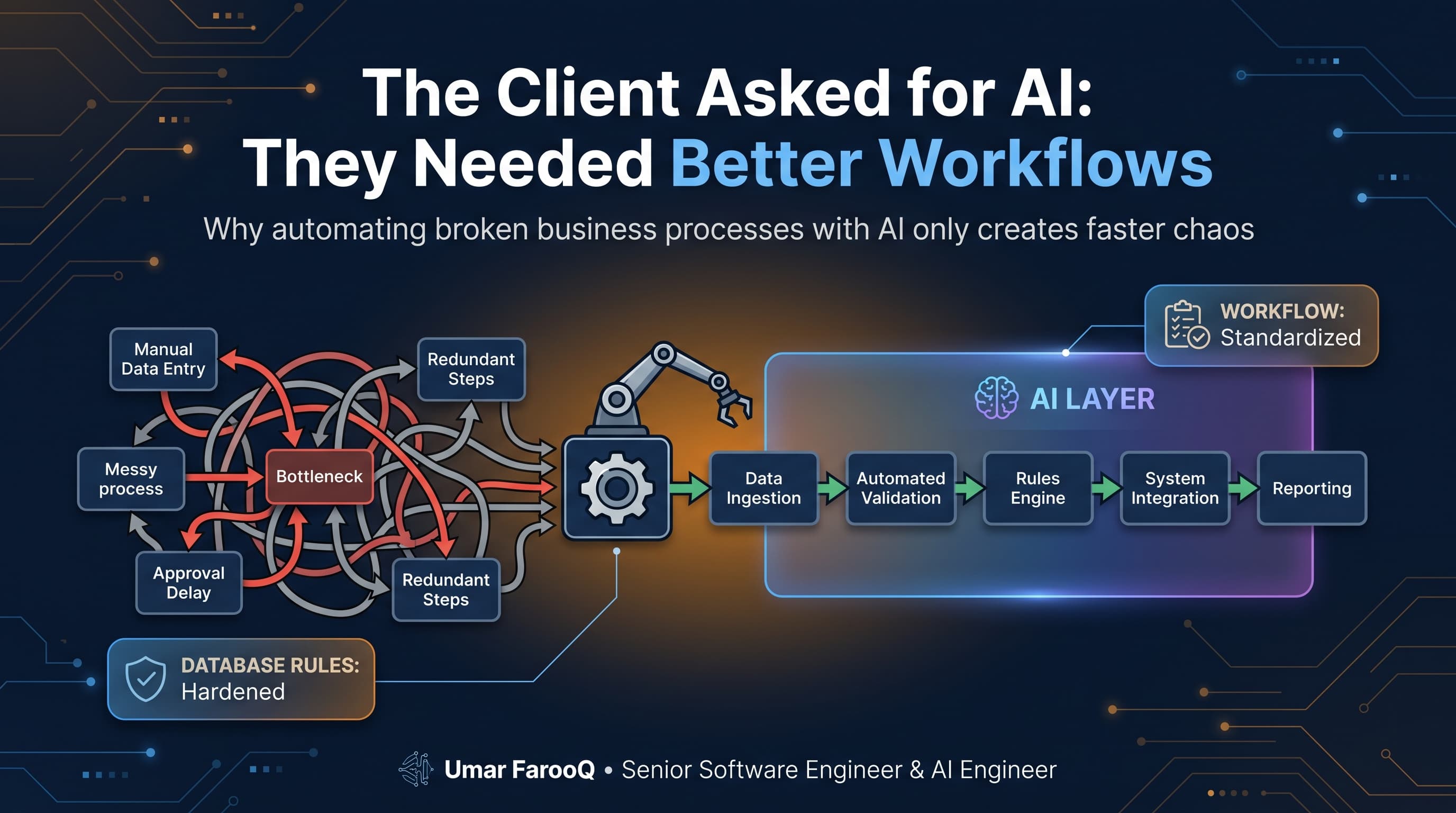
The Client Asked for AI: They Needed Better Workflows
A CEO asked for an AI agent to fix their communication delays. We analyzed their company and found 5 broken manual workflows. Why process beats buzzwords.
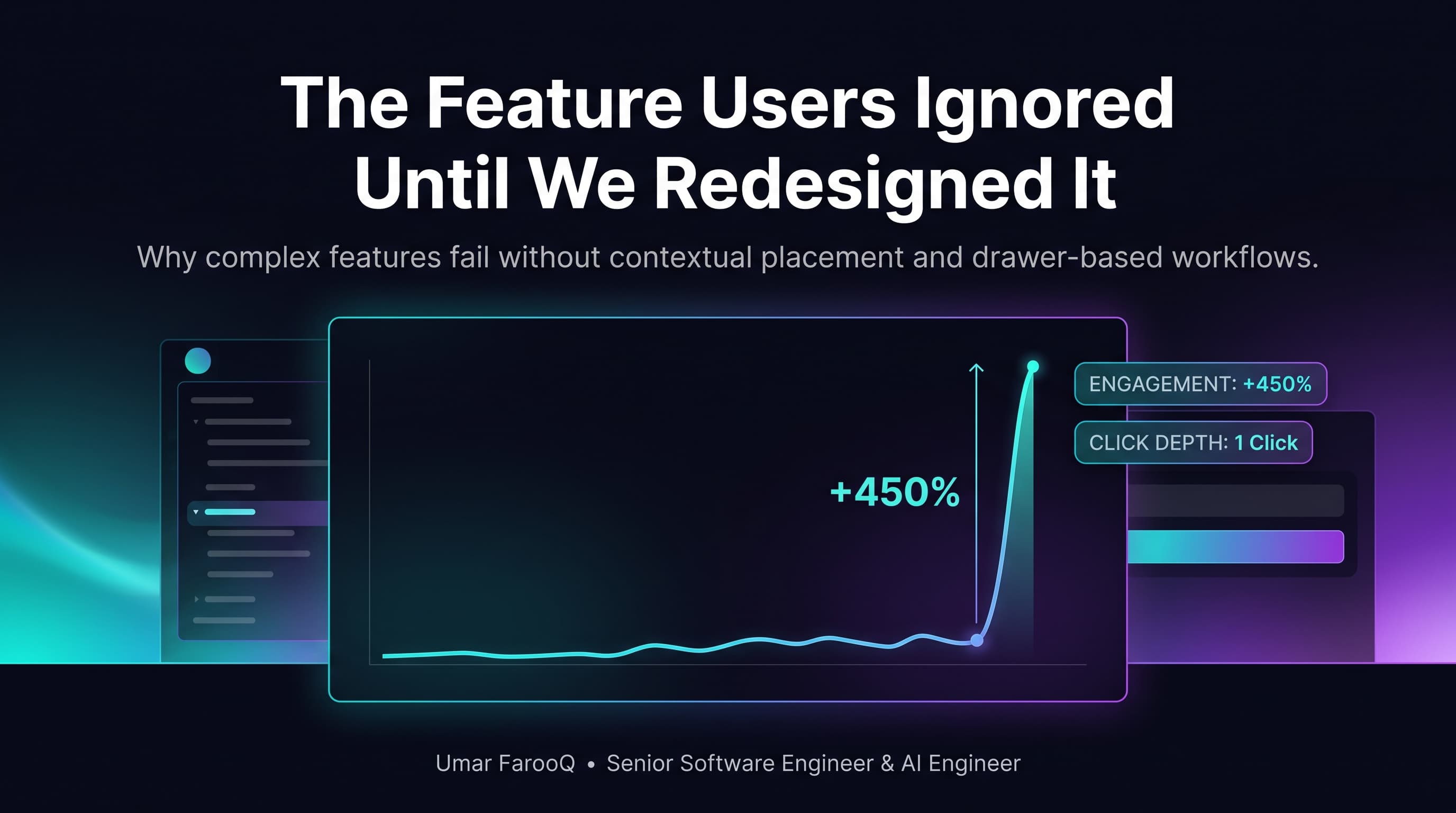
The Feature Users Ignored Until We Redesigned It
We spent months building a powerful analytics tool, but nobody clicked it. Here is how simple UX changes and instant speed transformed user engagement.