Why Business Knowledge Improves Software Engineering Skills
Great developers do not just write code; they solve expensive business problems. Here is why understanding business makes your technical work much better.
Umar Farooq
System Architect & Full-Stack Engineer
Direct Answer: Business knowledge improves software engineering skills because commercial context enables developers to write simpler, more durable code. When engineers understand how their company generates revenue, acquires customers, and absorbs operational risk, they stop over-engineering unnecessary technical abstractions and focus on high-impact architectures that directly drive business outcomes.
Early in their careers, many developers believe that senior engineering status is defined purely by algorithmic sophistication: knowing how to build a custom compiler, optimize red-black trees, or configure complex distributed message queues. Consequently, they treat code as art rather than an investment designed to yield a business return.
Over years architecting full-stack systems across Saudi Arabia and running commercial engineering ventures, I have learned an indisputable lesson: the best code is often the code you convince stakeholders not to write. Technical competence is foundational, but deep commercial understanding is what elevates a programmer into an indispensable technical leader.
The Dangerous Trap of Technical Over-Engineering
Engineers who lack business context frequently choose technologies to satisfy their personal curiosity rather than company goals. A startup with fifty daily transactions does not need a globally distributed multi-region Kubernetes cluster with Kafka streaming; it needs a clean Next.js application backed by a well-indexed PostgreSQL database that ships to market in three weeks.
As software management pioneer Martin Fowler highlights in his essays on Technical Debt and Architectural Payoffs, architectural complexity is an ongoing liability. Every unneeded microservice or external queue introduces maintenance overhead, server costs, and potential outage vectors that drain company resources.
Comparison: Pure Technologist vs Business-Aligned Engineer
Here is how business knowledge fundamentally alters everyday engineering decisions:
Decision Area | Pure Technologist (Coding in a Vacuum) | Business-Aligned Software Engineer |
|---|---|---|
Technology Selection | Picks trending frameworks and complex distributed tools | Selects battle-tested stacks (Next.js, Laravel) for fast time-to-market |
Feature Scoping | Builds every theoretical edge case and customization option | Partners with stakeholders to build the lean MVP that validates revenue |
Technical Debt | Refactors endlessly without clear commercial payoff | Pragmatically balances clean architecture with shipping deadlines |
Cost Awareness | Ignores cloud hosting and third-party API bills | Profiles token usage and serverless bills to protect gross margins |
Communication Style | Speaks in jargon (abstract classes, kubernetes pods) | Speaks in commercial value (conversion rates, churn, latency impact) |
Practical Implementation: Measuring the ROI of Performance Optimization
When a business-aligned engineer optimizes an application, they connect technical metrics directly to revenue KPIs. Below is an engineering telemetry pattern tracking checkout latency alongside conversion success:
// src/server/telemetry/businessMetrics.ts
import { redis } from "@/lib/redis";

interface CheckoutTelemetry {
  userId: string;
  durationMs: number;
  totalAmountCents: number;
  completedSuccessfully: boolean;
}

export async function recordCheckoutPerformance(event: CheckoutTelemetry) {
  // Aggregate latency vs conversion telemetry
  const latencyBucket = event.durationMs < 200 ? "fast_sub_200ms" : "slow_over_200ms";

  await Promise.all([
    redis.hincrby(`metrics:checkout:${latencyBucket}`, "totalAttempts", 1),
    event.completedSuccessfully
      ? redis.hincrby(`metrics:checkout:${latencyBucket}`, "successfulPurchases", 1)
      : redis.hincrby(`metrics:checkout:${latencyBucket}`, "abandonedPurchases", 1),
  ]);

  // If latency exceeds 500ms on high-value orders, alert engineering immediately
  if (event.durationMs > 500 && event.totalAmountCents > 100000) {
    console.warn(`⚠️ High Latency Impacting Enterprise Conversion: ${event.durationMs}ms for order $${event.totalAmountCents / 100}`);
  }
}
How to Develop Commercial Acumen as an Engineer
Building commercial acumen does not require an MBA. Start by asking product managers basic business questions: What is our customer acquisition cost (CAC)? Why do customers churn after ninety days? Which administrative tasks consume the most human labor inside our operations? Understanding these answers changes how you design database schemas and prioritize pull requests.
Frequently Asked Questions
Does business thinking distract from coding excellence?
Not at all. In fact, it sharpens technical excellence. When you understand the commercial stakes, you write cleaner code, design more resilient database transactions, and avoid spending weeks building features that nobody uses.
How does commercial context help during architectural debates?
It grounds technical discussions in objective reality. Instead of debating whether framework A is subjectively 'cleaner' than framework B, you evaluate which solution reduces operational risk, lowers maintenance costs, and enables faster customer onboarding.
What is the most valuable business metric for full-stack developers?
Time-to-Value (TTV). The ability to take a validated customer problem and safely ship a dependable, production-tested software solution into users' hands with minimal friction is the ultimate engineering superpower.
Partnering with Product and Marketing Teams
When engineers understand quarterly revenue goals and marketing release cycles, deployment planning becomes collaborative rather than adversarial. Instead of resisting urgent product releases with vague technical objections, business-savvy developers propose pragmatic phased rollouts—delivering critical functionality today while scheduling technical hardening in the following sprint.
Summary & Career Guidance
Industry benchmarks and authoritative engineering standards validate this methodology; explore Eric Evans' Domain-Driven Design reference guide for in-depth technical specifications and architectural trade-offs observed in high-scale enterprise environments.
Code is never the end goal; it is a mechanism to solve commercial challenges and create value. The software engineers who master both technical craftsmanship and business empathy become the leaders who shape the future of their organizations.
In our full-stack Laravel development practice and Next.js SaaS engineering services, business alignment is baked into every architecture we deliver.
To learn more about my personal journey bridging business and software engineering, visit my About Me profile or read through our Technical Blog Archive.
Looking for a senior technical partner who understands both your business model and your code? Reach out directly through my Connect page.

Umar Farooq
Author & ConsultantSpecializes in Laravel, Next.js, and AI products. 5+ years enterprise experience with 80+ delivered platforms and full source code ownership.
Related Engineering Insights
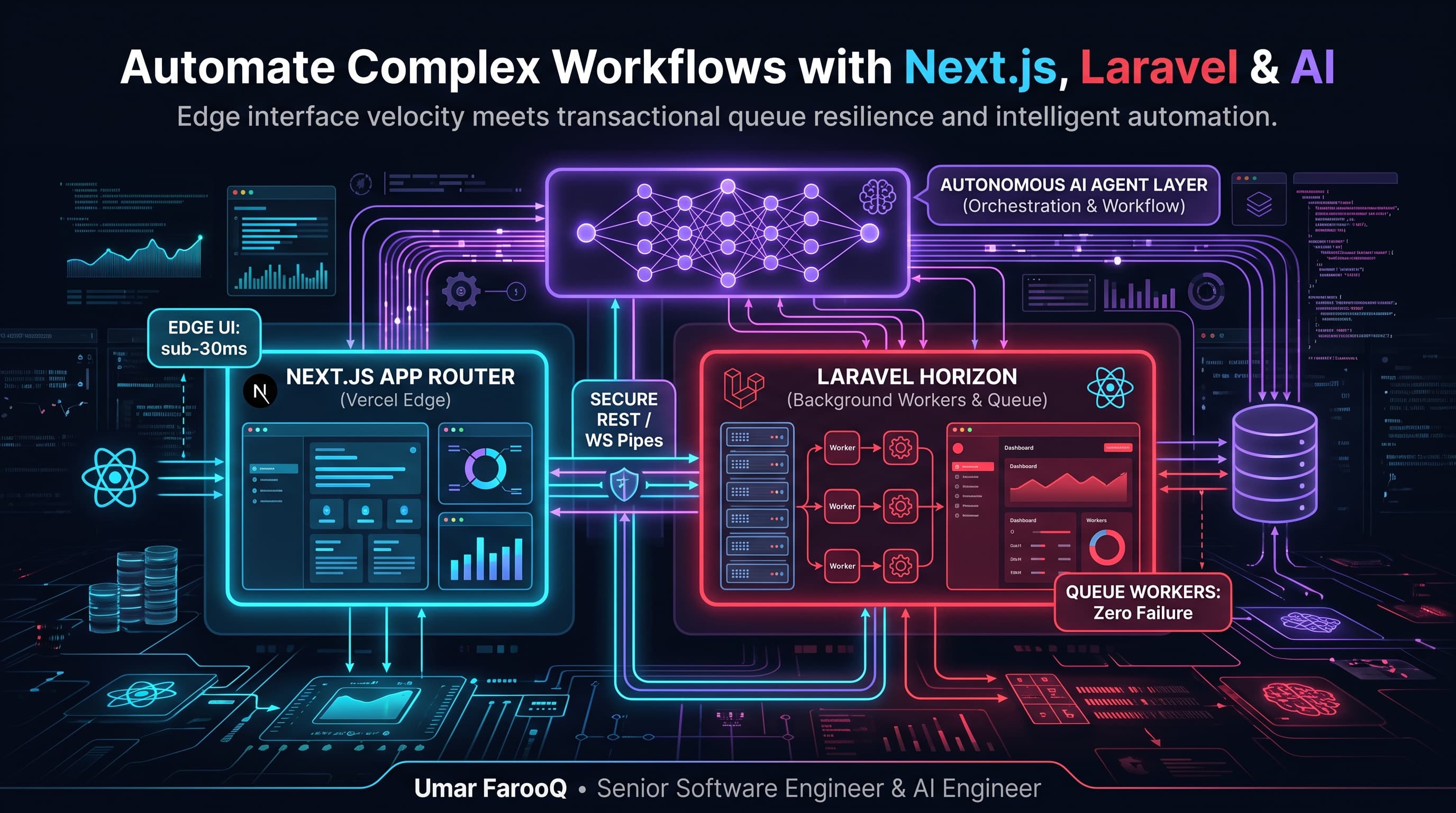
How to Automate Complex Business Workflows Using Next.js, Laravel, and AI Agents
Combine the speed of Next.js with the transactional power of Laravel and AI agents to automate complex business tasks with zero headaches.
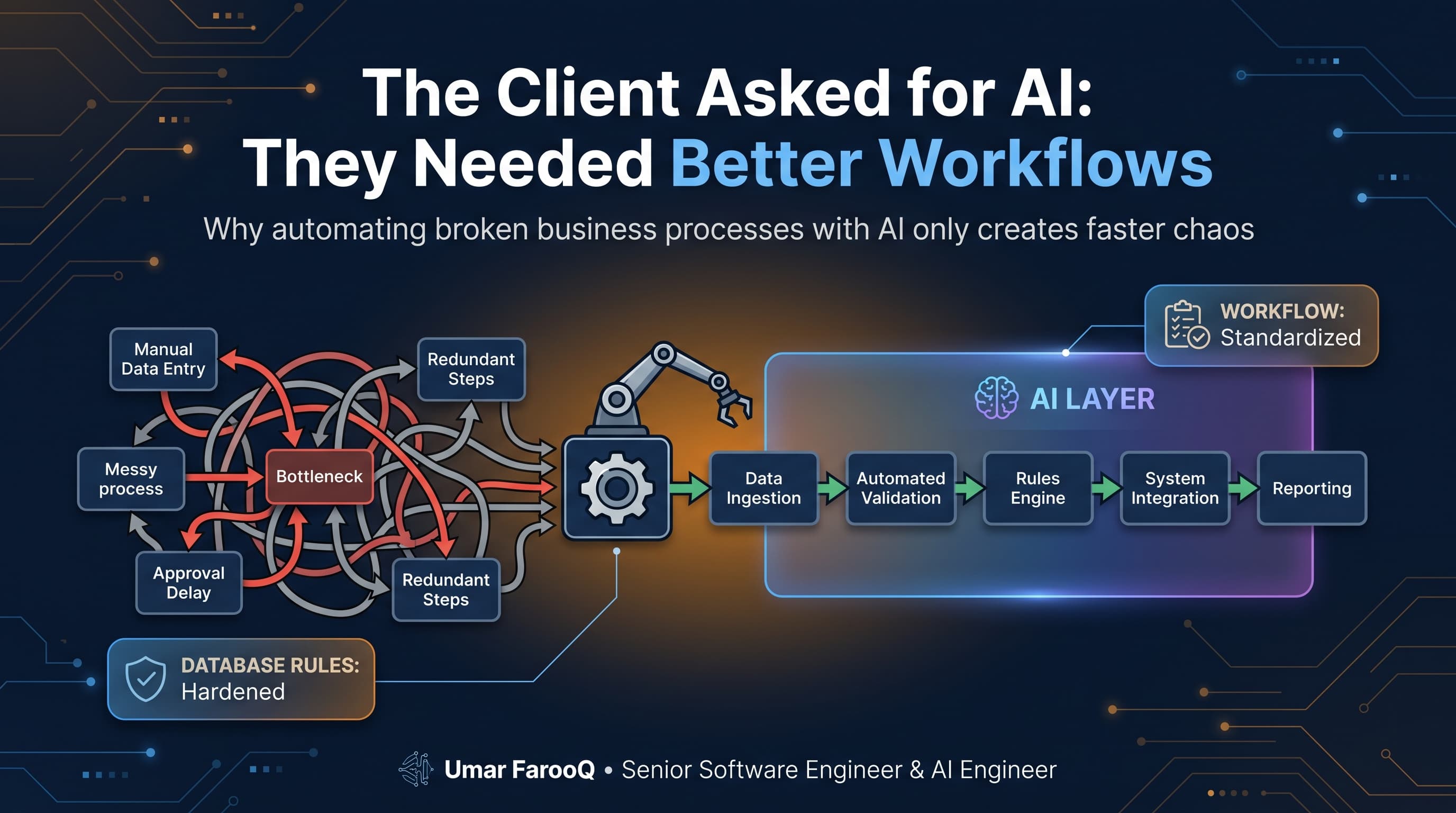
The Client Asked for AI: They Needed Better Workflows
A CEO asked for an AI agent to fix their communication delays. We analyzed their company and found 5 broken manual workflows. Why process beats buzzwords.
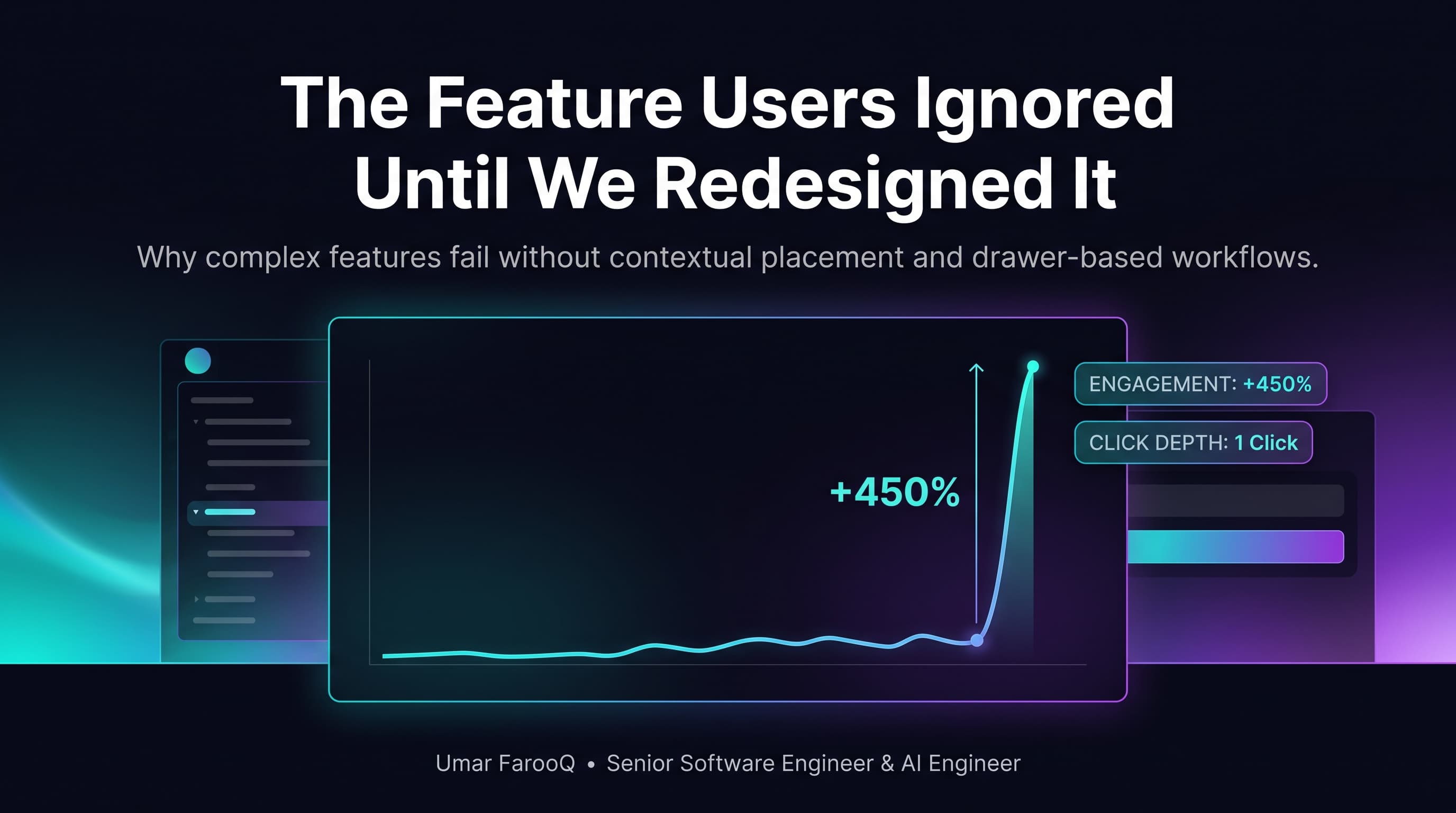
The Feature Users Ignored Until We Redesigned It
We spent months building a powerful analytics tool, but nobody clicked it. Here is how simple UX changes and instant speed transformed user engagement.