Why Prompt Engineering is Being Replaced in Software
Writing long conversational prompts to trick AI models is dying. Production software engineering demands structured outputs and deterministic schemas.
Umar Farooq
System Architect & Full-Stack Engineer
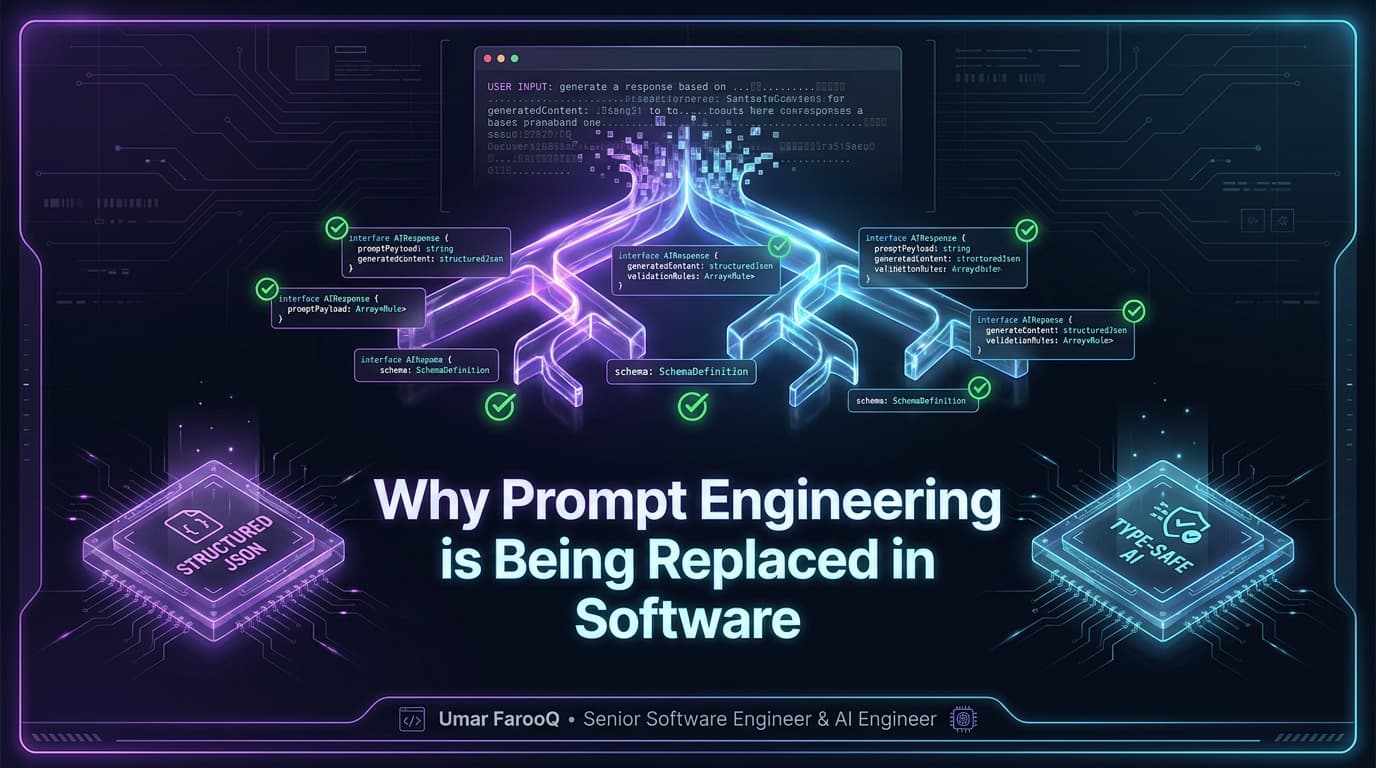
Direct Answer: Prompt engineering is being replaced in production software by deterministic software architectures: structured JSON schema enforcement, function calling, tool use, and vector retrieval. Rather than tweaking fragile natural-language adjectives to beg an LLM for consistent answers, modern systems enforce rigid schemas and transactional validators that guarantee 100% predictable software execution.
When generative AI models first entered mainstream software development, 'prompt engineering' was hailed as the definitive new technical skill. Developers spent hundreds of hours experimenting with magic phrases: 'You are an expert software architect', 'Think step-by-step', and 'Respond strictly in valid JSON without markdown tags'.
In commercial production, however, relying on linguistic persuasion to control mission-critical software is an architectural antipattern. Having engineered enterprise AI applications and automated pipelines across Saudi Arabia, I have witnessed the rapid obsolescence of manual prompting. Modern production software treats language models not as creative conversationalists, but as probabilistic reasoning engines bounded by deterministic code.
The Inherent Fragility of Natural Language Prompting
Natural language is inherently ambiguous. A prompt that returns valid JSON 98 times out of 100 will eventually output conversational preamble, unescaped quote characters, or hallucinated property names on request 99. When an automated billing or inventory endpoint receives invalid JSON, your backend throws an unhandled exception.
According to research from OpenAI Structured Outputs Documentation, constraining model decoding with Context-Free Grammars (CFGs) guarantees 100% schema adherence. This transforms AI outputs from unpredictable text into guaranteed JSON objects matching your exact TypeScript or Zod definitions.
Evolutionary Comparison: Manual Prompting vs Structured Schemas
Here is how AI integration patterns have shifted from early experimentation to production-grade engineering:
Architecture Attribute | Fragile Prompt Engineering (2023) | Deterministic Schema Architecture (2026) |
|---|---|---|
Format Enforcement | Begging in prompt ('Return ONLY valid JSON') | Grammar-constrained JSON schema with Zod validation |
Error Handling | Regex string parsing and manual retry loops | Native API rejection and automated schema self-healing |
Data Retrieval | Pasting massive unstructured documents into context | Semantic vector search with pgvector and metadata filtering |
Business Actions | Parsing free-form text to guess user intent | Typed tool-calling functions with explicit parameter schemas |
System Reliability | 85% to 92% consistency under varying inputs | 99.9%+ reliability with guaranteed runtime type safety |
Production Implementation: Structured Tool Calling with Zod
Below is a production-hardened example using TypeScript and modern AI tool calling, replacing vague prompts with strict validation schemas:
// src/server/ai/orderExtraction.ts
import { z } from "zod";

// Strict contract: The AI CANNOT output fields outside this schema
export const PurchaseOrderSchema = z.object({
  supplierName: z.string().min(2),
  orderNumber: z.string(),
  currency: z.enum(["USD", "SAR", "EUR"]),
  totalAmountCents: z.number().int().positive(),
  items: z.array(
    z.object({
      sku: z.string(),
      quantity: z.number().int().positive(),
      unitPriceCents: z.number().int().positive(),
    })
  ).min(1),
});

export type PurchaseOrder = z.infer<typeof PurchaseOrderSchema>;

// Tool Definition passed directly to model API
export const extractOrderTool = {
  name: "savePurchaseOrder",
  description: "Extracts validated commercial invoice parameters into the ERP database",
  parameters: PurchaseOrderSchema,
};
The Rise of Context Engines and RAG
Instead of writing endless few-shot examples inside multi-paragraph system prompts, modern architectures utilize Retrieval-Augmented Generation (RAG). By embedding documentation, catalog inventories, and customer history into vector databases like PostgreSQL with pgvector, the application dynamically injects only the three most relevant reference snippets into the model's immediate context window.
Automated Schema Self-Healing Pipelines
When a schema validation error occurs, production applications should not simply throw an unhandled 500 error. Instead, the runtime validator passes the exact Zod parsing error back to the language model in a corrective feedback loop: 'Your previous output missed the required taxId field; re-generate conforming strictly to the schema.' In 99% of cases, the model corrects its error on the second attempt automatically.
Frequently Asked Questions
Is prompt engineering completely useless now?
Prompt design still matters for clarifying task goals and setting operational tone. However, relying on prompting alone to enforce structured formats, validation rules, or deterministic business execution is obsolete. Software engineers now enforce those constraints with code and schemas.
What is the difference between JSON mode and Structured Outputs?
JSON mode guarantees that the output is syntactically valid JSON, but does not guarantee that required properties exist or match specific types. Structured Outputs enforce a strict JSON Schema mathematically during token generation, guaranteeing that every key and type matches your specification.
How does schema enforcement affect API latency?
Schema compilation adds a negligible 10 to 30 millisecond initialization overhead on the first request, which is then cached by the provider. In return, it eliminates complex multi-step retry loops on failed parsing, resulting in faster and dramatically more reliable responses overall.
Summary & Technical Takeaway
Industry benchmarks and authoritative engineering standards validate this methodology; explore OpenAI API Reference on Structured JSON Outputs for in-depth technical specifications and architectural trade-offs observed in high-scale enterprise environments.
Building enterprise software with AI is not about finding magical words; it is about applying proven software engineering discipline to probabilistic models. Enforcing schemas, using tool calling, and grounding outputs with retrieval turns AI into a predictable, production-grade engine.
In our AI product and mobile development practice and enterprise Next.js SaaS engineering services, we build robust applications that eliminate prompt fragility.
To discover more about our AI engineering methodology, visit my About Me page or explore case studies on the Engineering Blog.
Ready to replace brittle AI prompts with rock-solid, production-grade architectures? Connect with me directly on my Connect page.

Umar Farooq
Author & ConsultantSpecializes in Laravel, Next.js, and AI products. 5+ years enterprise experience with 80+ delivered platforms and full source code ownership.
Related Engineering Insights
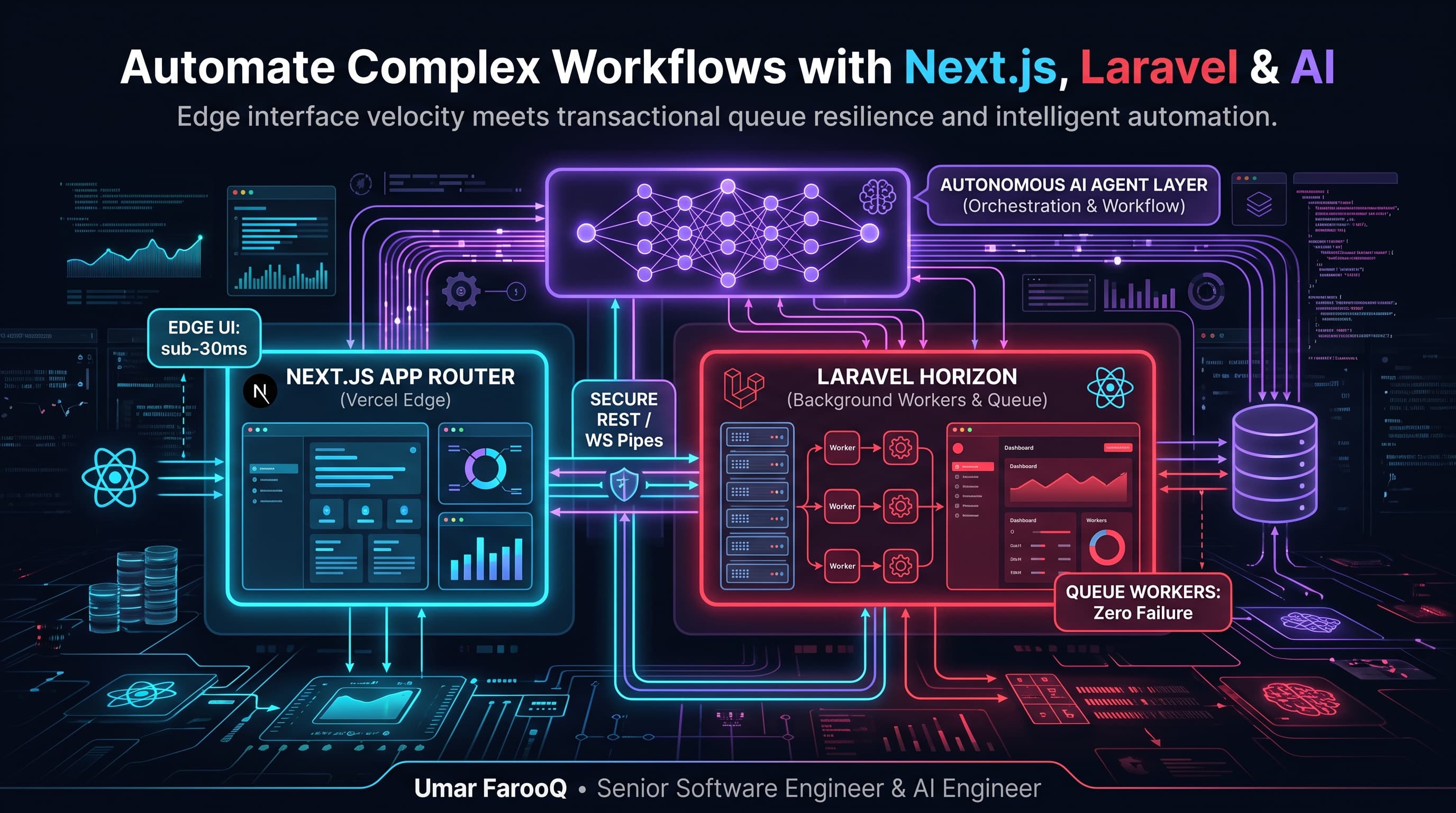
How to Automate Complex Business Workflows Using Next.js, Laravel, and AI Agents
Combine the speed of Next.js with the transactional power of Laravel and AI agents to automate complex business tasks with zero headaches.
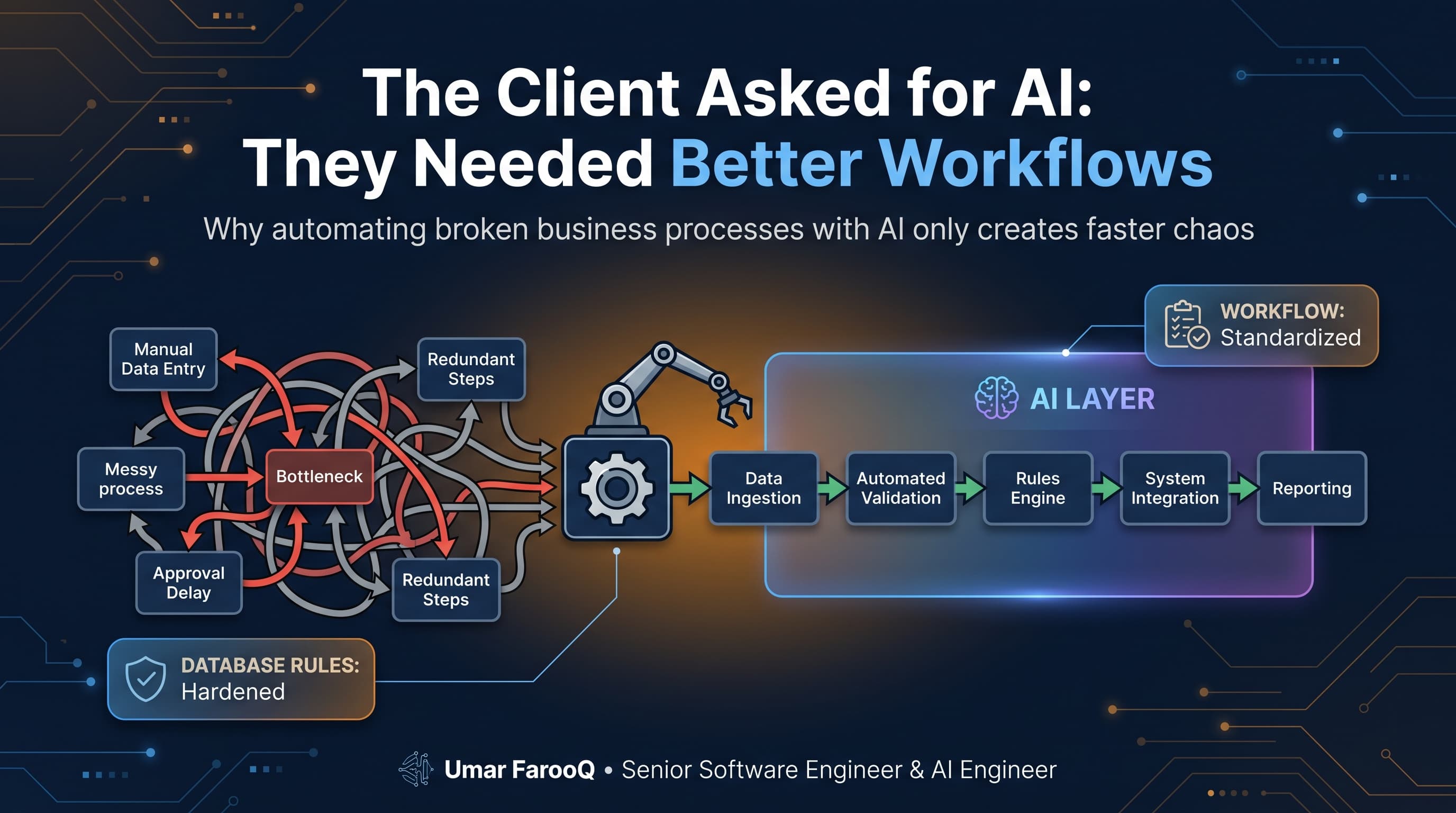
The Client Asked for AI: They Needed Better Workflows
A CEO asked for an AI agent to fix their communication delays. We analyzed their company and found 5 broken manual workflows. Why process beats buzzwords.
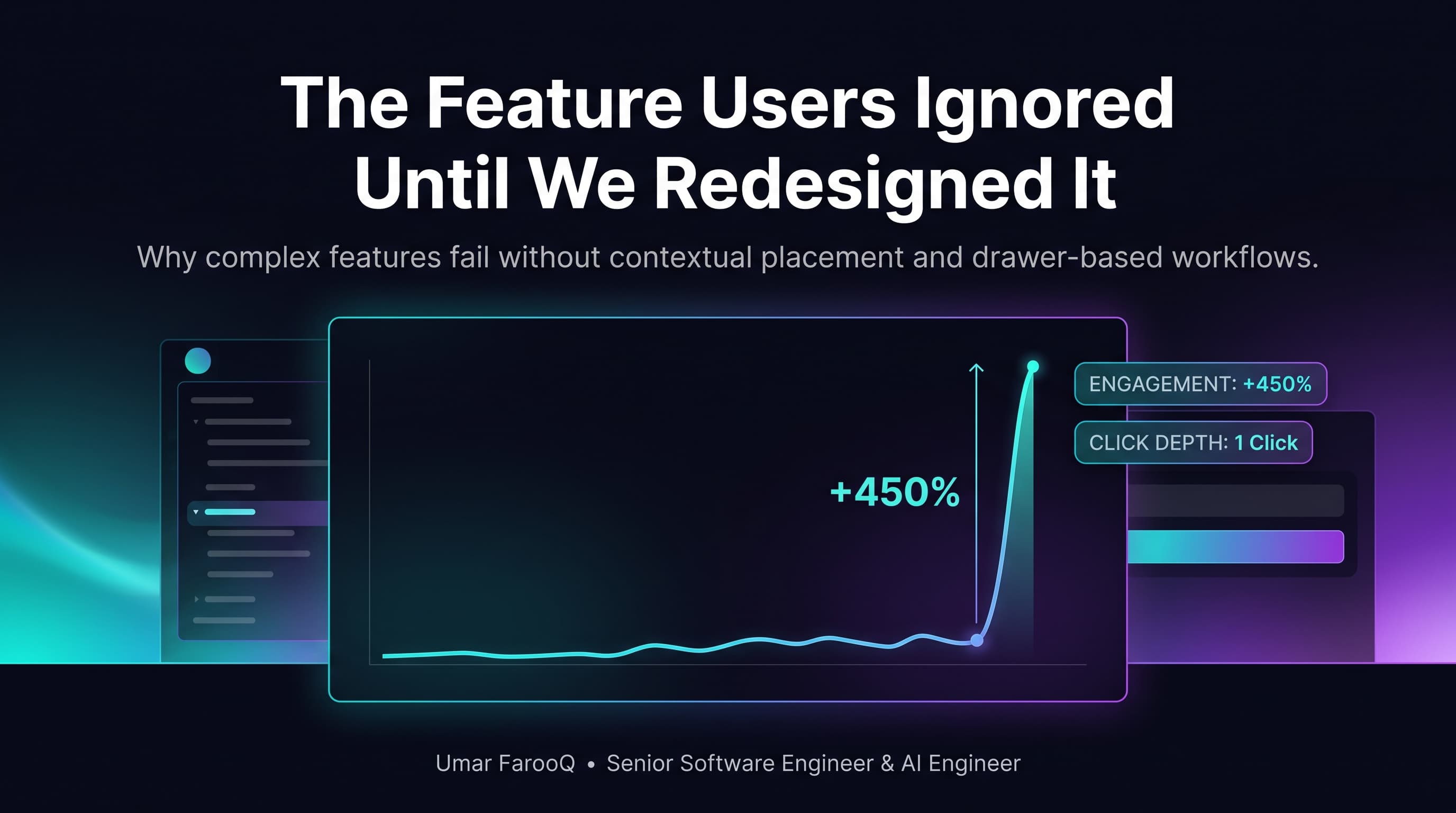
The Feature Users Ignored Until We Redesigned It
We spent months building a powerful analytics tool, but nobody clicked it. Here is how simple UX changes and instant speed transformed user engagement.