Why Traditional SaaS Dashboards Will Disappear Soon
Users do not want to look at 20 confusing charts. Explore how modern AI assistants and action workflows are replacing old-school SaaS dashboards.
Umar Farooq
System Architect & Full-Stack Engineer

Direct Answer: Traditional SaaS dashboards are becoming obsolete because modern users demand automated action rather than passive observation. The conventional model of forcing operators to log into static dashboards, filter tabular data, and export CSVs is being superseded by autonomous AI agents and event-driven interfaces that detect business anomalies and execute workflows proactively.
For the past decade, the standard SaaS template has remained virtually unchanged: a left-hand navigation sidebar, a header with a user profile avatar, and a central grid of analytical charts and data tables. Every business platform—from billing software and CRMs to ERP platforms—assumed that users wanted a centralized cockpit to view data.
However, modern business operators are experiencing severe dashboard fatigue. Having engineered SaaS applications and enterprise platforms for clients across Saudi Arabia and remote organizations, I have observed a profound shift in user behavior: customers do not want to spend two hours analyzing charts to discover what went wrong; they want the software to fix the problem automatically.
From Passive Analytics to Autonomous Action
The fundamental flaw of traditional dashboards is that they shift the burden of cognitive synthesis onto the human user. A procurement dashboard displaying a line chart of rising shipping costs requires a human to notice the trend, investigate individual suppliers, calculate alternative margins, and email alternative vendors.
In modern agentic architectures powered by platforms like the Anthropic Claude API and Next.js Server Actions, the system observes telemetry, flags the discrepancy, calculates alternative vendor contracts, and presents an actionable confirmation button directly in Slack or WhatsApp: 'Vendor A increased rates by 18%; approve switch to Vendor B to save $4,200 monthly?'
Evolutionary Matrix: Traditional SaaS vs Agentic Action Platforms
Here is how user interaction models are evolving across core software capabilities:
Capability Area | Traditional SaaS Dashboard Model | Modern Agentic Action Model |
|---|---|---|
User Interaction | Manual navigation through multi-tab menus | Conversational and contextual action triggers |
Data Processing | User manually filters, sorts, and exports CSVs | AI agent synthesizes data and surfaces root causes |
Incident Response | Operator spots anomaly hours after it happens | System triggers automated remediation instantly |
Mobile Experience | Cluttered desktop charts squeezed onto phones | Lightweight conversational cards with one-tap approvals |
Integration Layer | Passive REST read endpoints | Tool-calling agents executing cross-platform workflows |
Production Code Pattern: Automated Anomaly Detection Agent
Below is a Next.js Server Action illustrating how an agentic backend analyzes incoming financial data, detects anomalies, and generates actionable notifications without requiring a user to visit an analytics page:
// src/server/actions/financialAgent.ts
"use server";

import { db } from "@/lib/db";
import { sendTelegramNotification } from "@/lib/telegram";

export async function auditDailyExpenditures(organizationId: string) {
  const [currentWeek, baseline] = await Promise.all([
    db.expense.aggregate({ where: { organizationId, createdAt: { gte: new Date(Date.now() - 7 * 86400000) } }, _sum: { amount: true } }),
    db.expense.aggregate({ where: { organizationId, createdAt: { gte: new Date(Date.now() - 30 * 86400000) } }, _avg: { amount: true } }),
  ]);

  const currentTotal = currentWeek._sum.amount || 0;
  const expectedThreshold = (baseline._avg.amount || 0) * 1.35; // 35% anomaly threshold

  if (currentTotal > expectedThreshold) {
    const alertMessage = `⚠️ *Financial Alert*: Weekly expenditures ($${currentTotal.toLocaleString()}) exceeded normal baseline by 35%+. Review and approve automated vendor audit.`;
    await sendTelegramNotification(alertMessage, [
      { text: "Approve Vendor Audit", callback_data: `audit_${organizationId}` },
      { text: "Dismiss Alert", callback_data: "dismiss" }
    ]);
  }

  return { analyzed: true };
}
The Rise of Headless and Conversational SaaS
As artificial intelligence capabilities mature, the most valuable business software will be increasingly invisible. Rather than visiting twenty distinct browser tabs each morning, founders and operational managers will interact with intelligent software through unified messaging protocols, mobile notifications, and automated webhooks.
Frequently Asked Questions
Will SaaS web interfaces disappear entirely?
No. Deep configuration interfaces, system administration consoles, and audit log viewers will always require visual web pages. However, daily operational management will shift from manual dashboard navigation to automated, event-driven action cards.
How does this shift affect SaaS pricing models?
As users spend less time clicking buttons inside web apps, traditional per-seat monthly subscriptions become less relevant. SaaS companies are rapidly transitioning to value-based and outcome-based pricing models, charging per successful workflow execution or saved operational cost.
How can founders prepare existing products for this shift?
Expose all core business logic through clean, idempotent API endpoints and webhooks. Software that possesses well-structured APIs can easily be adapted into agentic tools, whereas monolithic apps with logic trapped inside UI view components will struggle to adapt.
Summary & Strategic Outlook
Industry benchmarks and authoritative engineering standards validate this methodology; explore Nielsen Norman Group UX research on enterprise search for in-depth technical specifications and architectural trade-offs observed in high-scale enterprise environments.
The future of enterprise software belongs to systems that take initiative. Replacing passive data displays with proactive, automated workflows transforms software from an administrative chore into a high-leverage business partner.
In our AI product and mobile development practice and Next.js SaaS engineering services, we build next-generation applications with proactive agent workflows.
To discover more about our technical engineering approach, explore my About Me page or read our complete essay library on the Engineering Blog.
Planning to modernize your SaaS platform with autonomous agent workflows? Book an architecture strategy session on my Connect page.

Umar Farooq
Author & ConsultantSpecializes in Laravel, Next.js, and AI products. 5+ years enterprise experience with 80+ delivered platforms and full source code ownership.
Related Engineering Insights
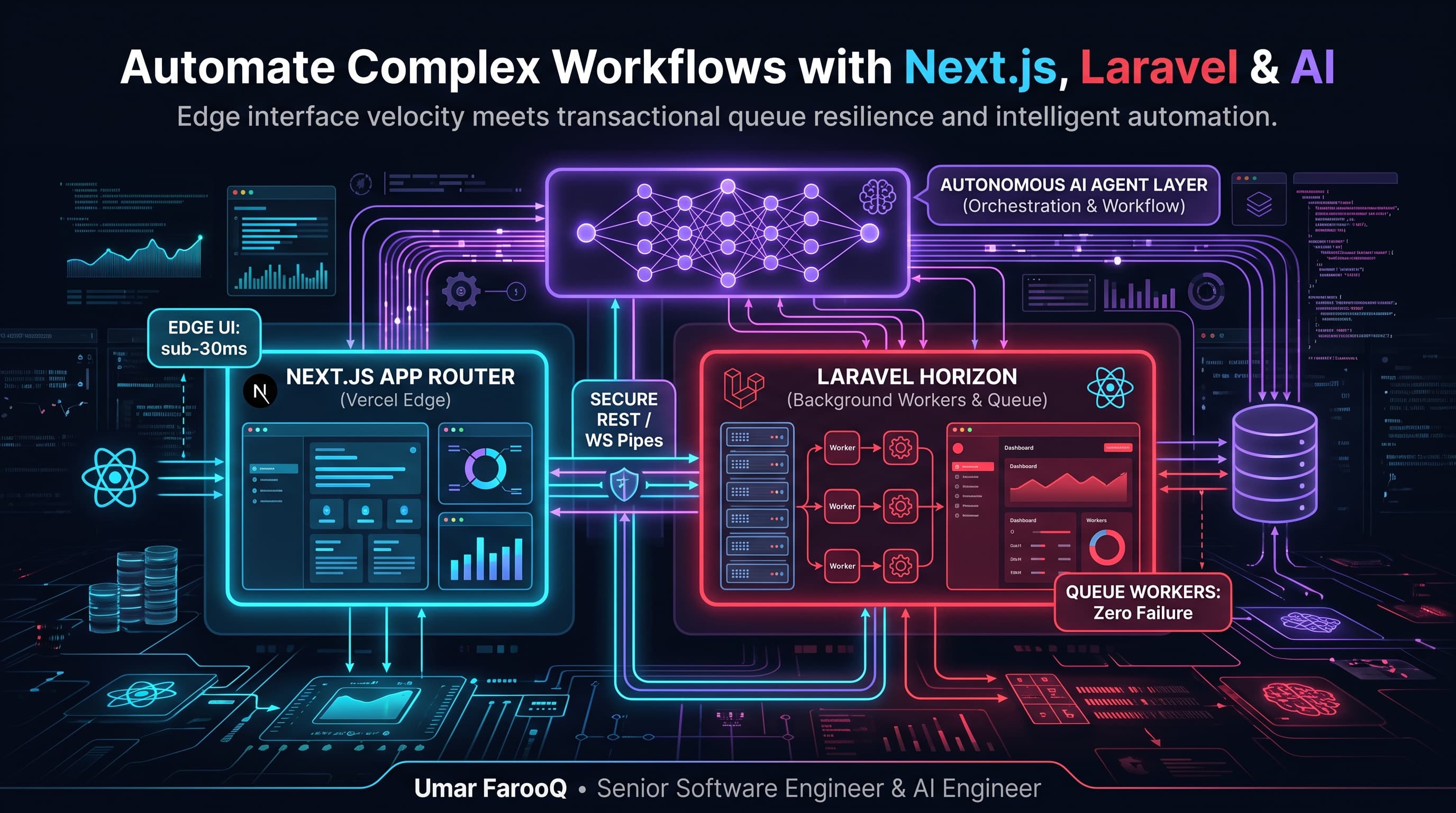
How to Automate Complex Business Workflows Using Next.js, Laravel, and AI Agents
Combine the speed of Next.js with the transactional power of Laravel and AI agents to automate complex business tasks with zero headaches.
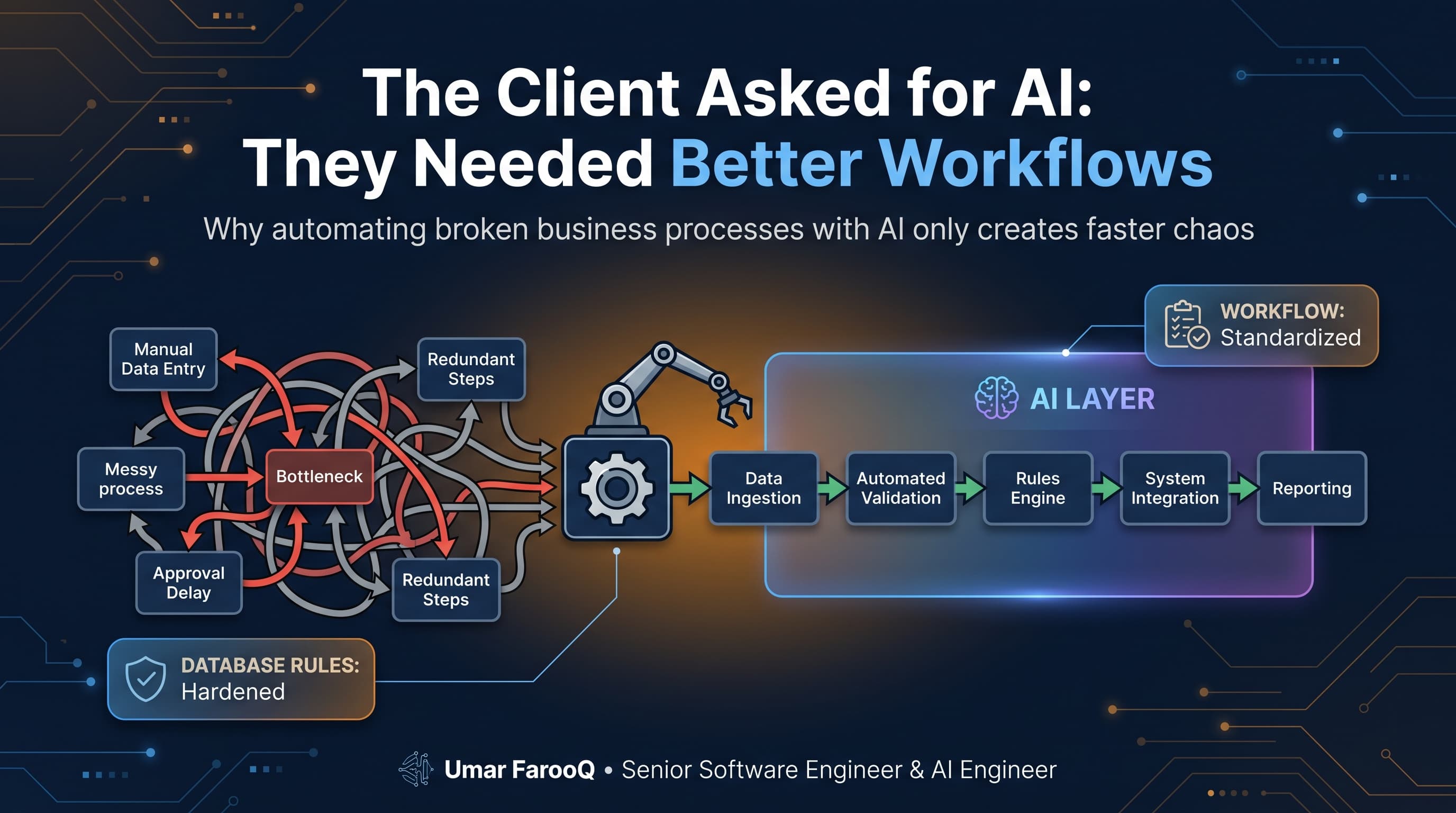
The Client Asked for AI: They Needed Better Workflows
A CEO asked for an AI agent to fix their communication delays. We analyzed their company and found 5 broken manual workflows. Why process beats buzzwords.
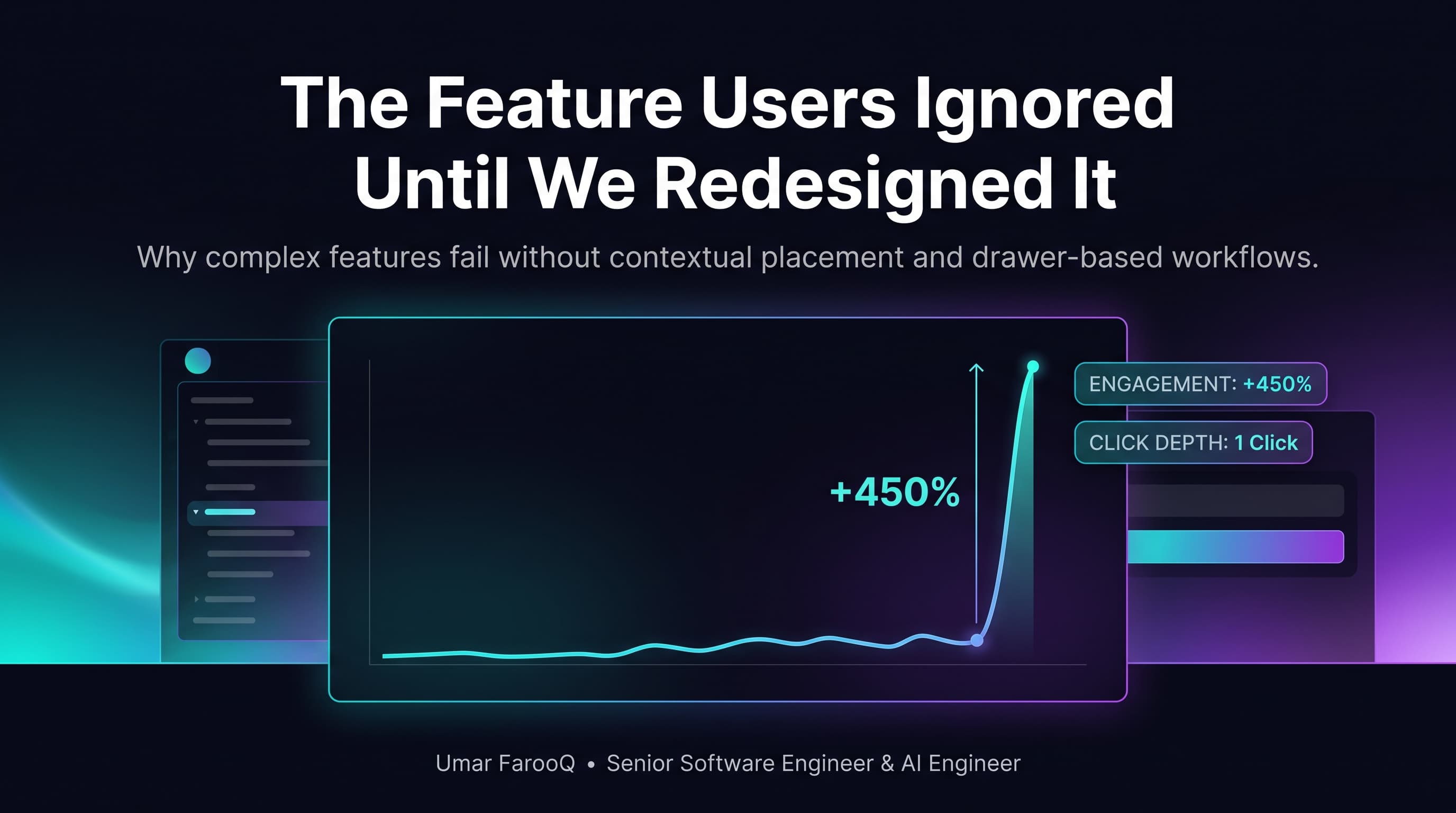
The Feature Users Ignored Until We Redesigned It
We spent months building a powerful analytics tool, but nobody clicked it. Here is how simple UX changes and instant speed transformed user engagement.