Writing Clean and Readable Code for Production Systems
Code is read ten times more often than it is written. Discover simple rules to write software that is clean, readable, and easy to maintain.
Umar Farooq
System Architect & Full-Stack Engineer
Direct Answer: Writing clean code for production systems requires prioritizing human readability and operational predictability over clever, terse syntax. By utilizing guard clauses to reduce nesting, naming functions around business domain intent, eliminating hidden side effects, and writing self-documenting type interfaces, engineering teams significantly reduce maintenance overhead and bug recurrence.
There is a stark difference between code that merely runs and code designed to thrive in production for years. In academic exercises and competitive coding, developers are rewarded for concise, one-line abstractions and clever algorithmic shortcuts. In commercial production environments, however, clever code is an operational liability.
Over years architecting enterprise applications across Riyadh and global startup ecosystems, I have repeatedly seen that the real cost of software is never the initial build—it is maintenance. When an on-call engineer must debug an outage at two in the morning, clean, predictable code is the difference between a ten-minute fix and a catastrophic multi-hour outage.
The Core Pillars of Production-Grade Code
Clean software engineering is governed by foundational principles outlined in Martin Fowler's Refactoring Architecture Guides and Robert C. Martin's clean code practices. In production systems, four conventions yield the highest return on investment:
Early Return Guard Clauses: Eliminate deep arrow-shaped nesting by validating conditions and returning immediately, keeping the happy path flat and readable.
Explicit Domain Naming: Variables and functions should describe their real business intent (e.g. isSubscriptionEligibleForGracePeriod) rather than technical mechanics (e.g. checkData).
Zero Hidden Side Effects: Functions should perform exactly what their signature promises without quietly modifying global state or executing secondary database mutations.
Strict Type Safety: Leverage TypeScript or strict PHP typing to encode business invariants at compile time, eliminating null pointer exceptions.
Comparison: Deeply Nested Legacy Code vs Clean Guard Clauses
Notice how refactoring nested conditional logic into clean guard clauses improves cognitive readability:
Attribute | Deeply Nested Legacy Pattern | Production Clean Code Pattern |
|---|---|---|
Cognitive Load | High (must track 4+ indentation levels) | Low (reads sequentially top-to-bottom) |
Edge Case Visibility | Buried at the bottom of long else blocks | Handled immediately at the top of the function |
Refactoring Risk | High risk of breaking closing bracket pairs | Isolated guards that can be modified safely |
Testability | Requires complex multi-branch test matrices | Each guard condition maps directly to one unit test |
Production Refactoring Example: Payment Processing Flow
Below is a comparison of typical nested code alongside the clean, production-hardened refactor:
// ❌ DIFFICULT TO MAINTAIN: Deep indentation, nested ifs, hidden exceptions
function processPaymentBad(user: any, amount: number) {
  if (user != null) {
    if (user.isActive) {
      if (amount > 0) {
        if (user.walletBalance >= amount) {
          user.walletBalance -= amount;
          return { success: true, balance: user.walletBalance };
        } else {
          return { success: false, error: "Insufficient funds" };
        }
      } else {
        return { success: false, error: "Invalid amount" };
      }
    } else {
      return { success: false, error: "User is inactive" };
    }
  } else {
    return { success: false, error: "User not found" };
  }
}

// ✅ PRODUCTION CLEAN: Flat guard clauses, strict validation, predictable return
export interface PaymentResult {
  success: boolean;
  remainingBalance?: number;
  error?: string;
}

export function processPaymentClean(user: UserProfile | null, amount: number): PaymentResult {
  if (!user) return { success: false, error: "User not found" };
  if (!user.isActive) return { success: false, error: "User account is suspended" };
  if (amount <= 0) return { success: false, error: "Payment amount must be greater than zero" };
  if (user.walletBalance < amount) return { success: false, error: "Insufficient wallet balance" };

  // Core business logic executes cleanly without nested indentation
  user.walletBalance -= amount;
  return { success: true, remainingBalance: user.walletBalance };
}
Frequently Asked Questions
Does writing cleaner code slow down feature delivery?
Only for the first few days of a project. Teams that write clean, well-tested code consistently deliver features faster after the first month because they spend minimal time debugging regressions, wrestling with circular dependencies, or deciphering confusing legacy functions.
How long should a production function be?
As a standard guideline, aim for functions that perform a single cohesive responsibility within 15 to 30 lines. If a function requires scrolling across multiple screens or handles multiple disparate business operations, it should be decomposed into smaller, composable helpers.
What is the best way to enforce clean code in teams?
Automate code style enforcement using linters (ESLint, Prettier, PHP-CS-Fixer) in pre-commit git hooks and CI pipelines. Automating formatting frees human code reviewers to focus on architectural design, domain logic, and security rather than debating indentation.
Summary & Architecture Next Steps
Industry benchmarks and authoritative engineering standards validate this methodology; explore Robert C. Martin's Clean Architecture principles for in-depth technical specifications and architectural trade-offs observed in high-scale enterprise environments.
Writing clean code is a discipline of empathy for your future self and your engineering teammates. By keeping your functions focused, using guard clauses, and enforcing type safety, you build software assets that remain agile and resilient over years of commercial operation.
In our Next.js SaaS development practice and enterprise Laravel engineering services, clean code architecture and automated testing pipelines are built into every release.
To discover more about our software craftsmanship standards, review my About Me page or explore case studies on the Technical Blog Hub.
Need a senior architectural review or code quality refactor for your production platform? Book an engineering consultation directly on my Connect page.

Umar Farooq
Author & ConsultantSpecializes in Laravel, Next.js, and AI products. 5+ years enterprise experience with 80+ delivered platforms and full source code ownership.
Related Engineering Insights
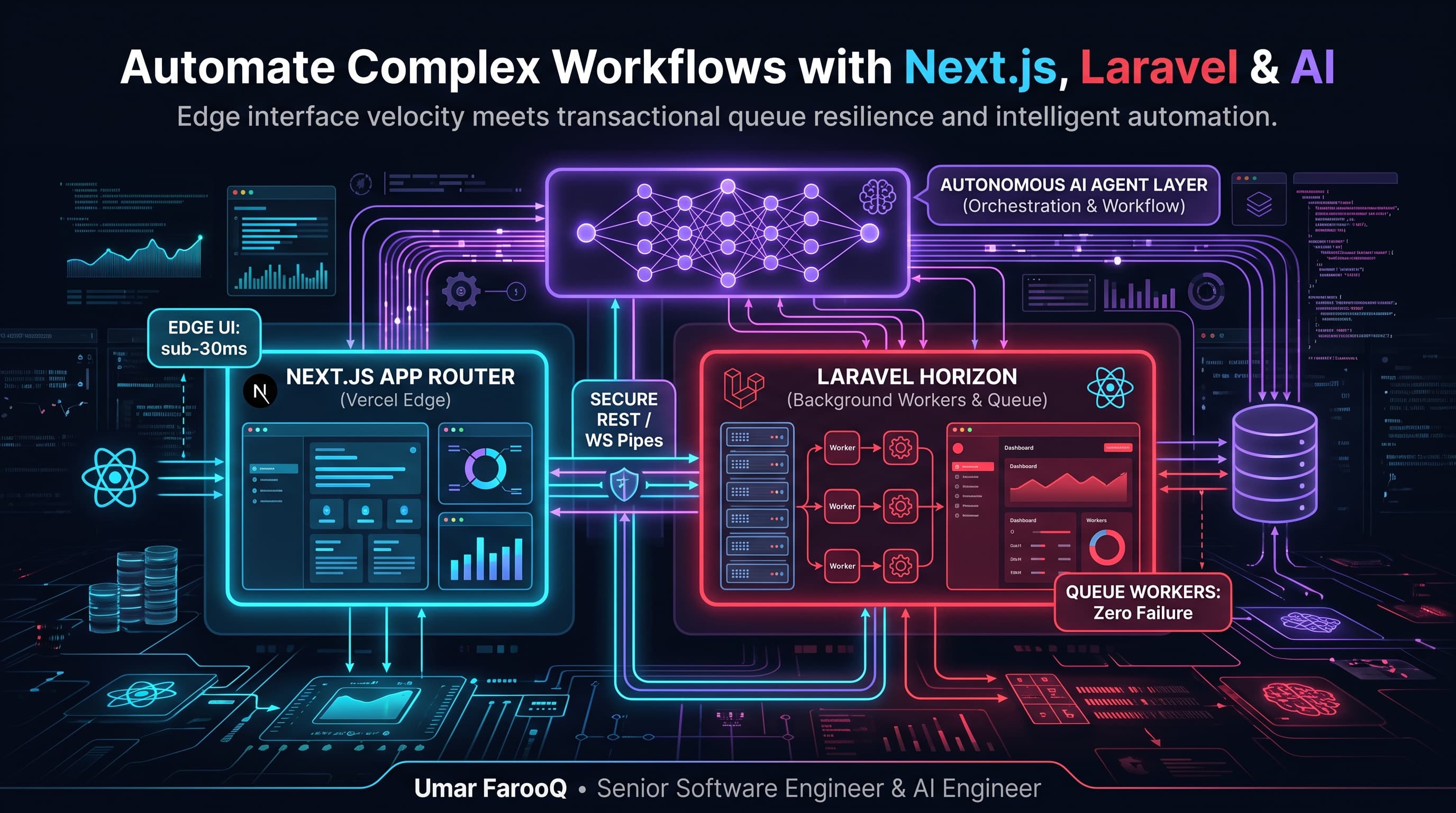
How to Automate Complex Business Workflows Using Next.js, Laravel, and AI Agents
Combine the speed of Next.js with the transactional power of Laravel and AI agents to automate complex business tasks with zero headaches.
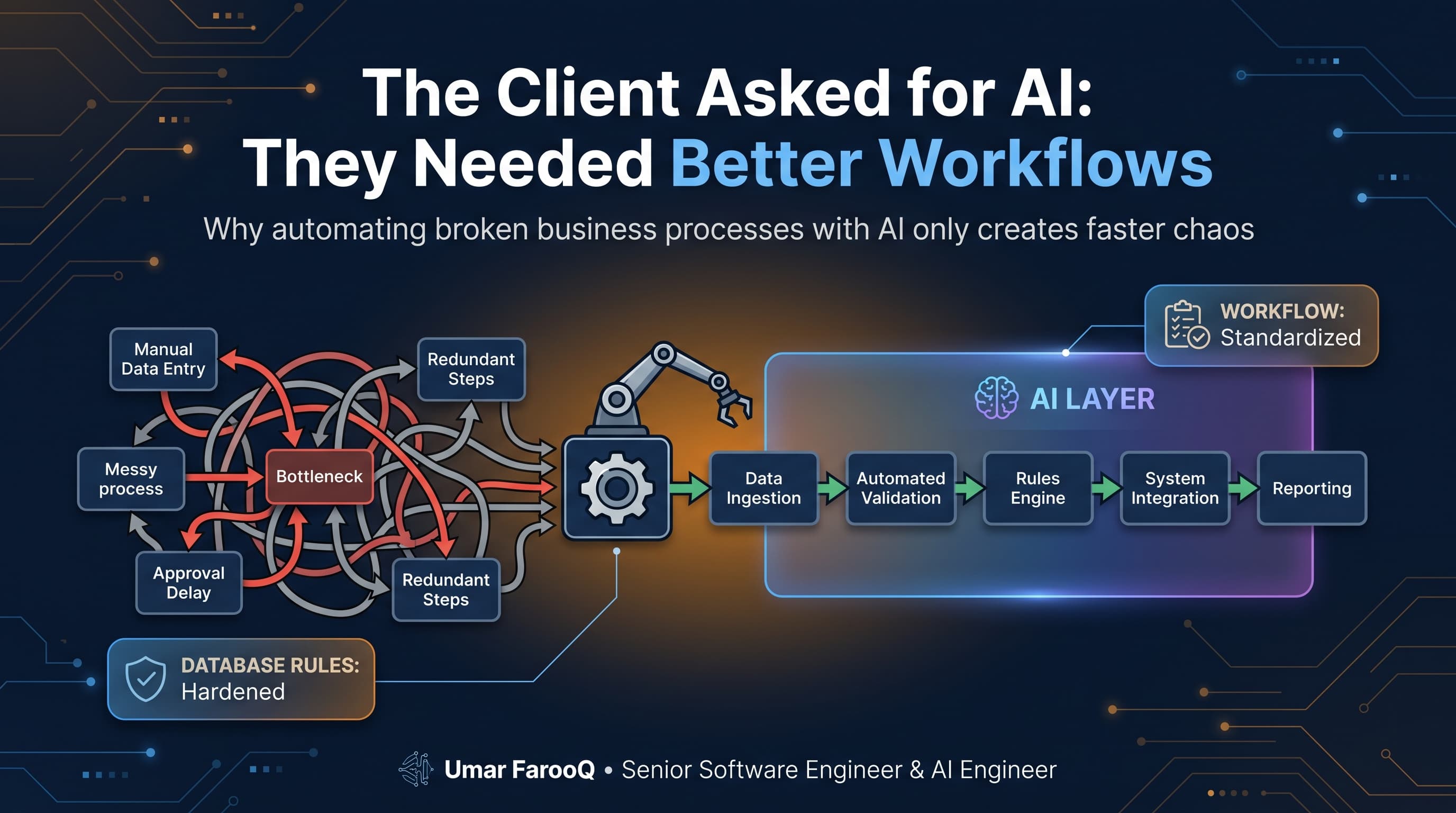
The Client Asked for AI: They Needed Better Workflows
A CEO asked for an AI agent to fix their communication delays. We analyzed their company and found 5 broken manual workflows. Why process beats buzzwords.
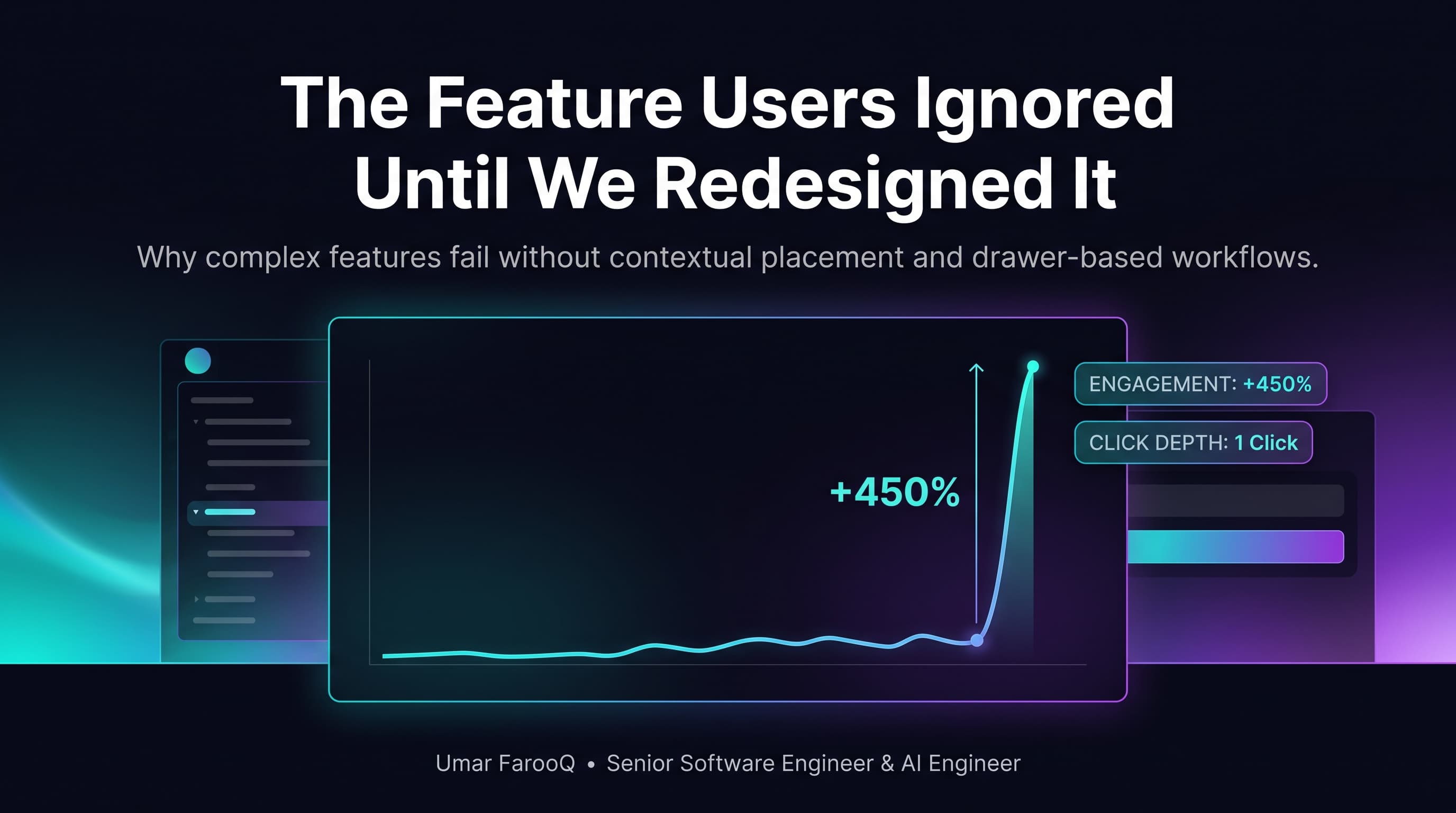
The Feature Users Ignored Until We Redesigned It
We spent months building a powerful analytics tool, but nobody clicked it. Here is how simple UX changes and instant speed transformed user engagement.