Mada Payment Gateway Laravel Comparison
Mada payment integration in Laravel compared: Moyasar, Tap and HyperPay webhook handling, Apple Pay support and sandbox quality, with production code.
Umar Farooq
System Architect & Full-Stack Engineer
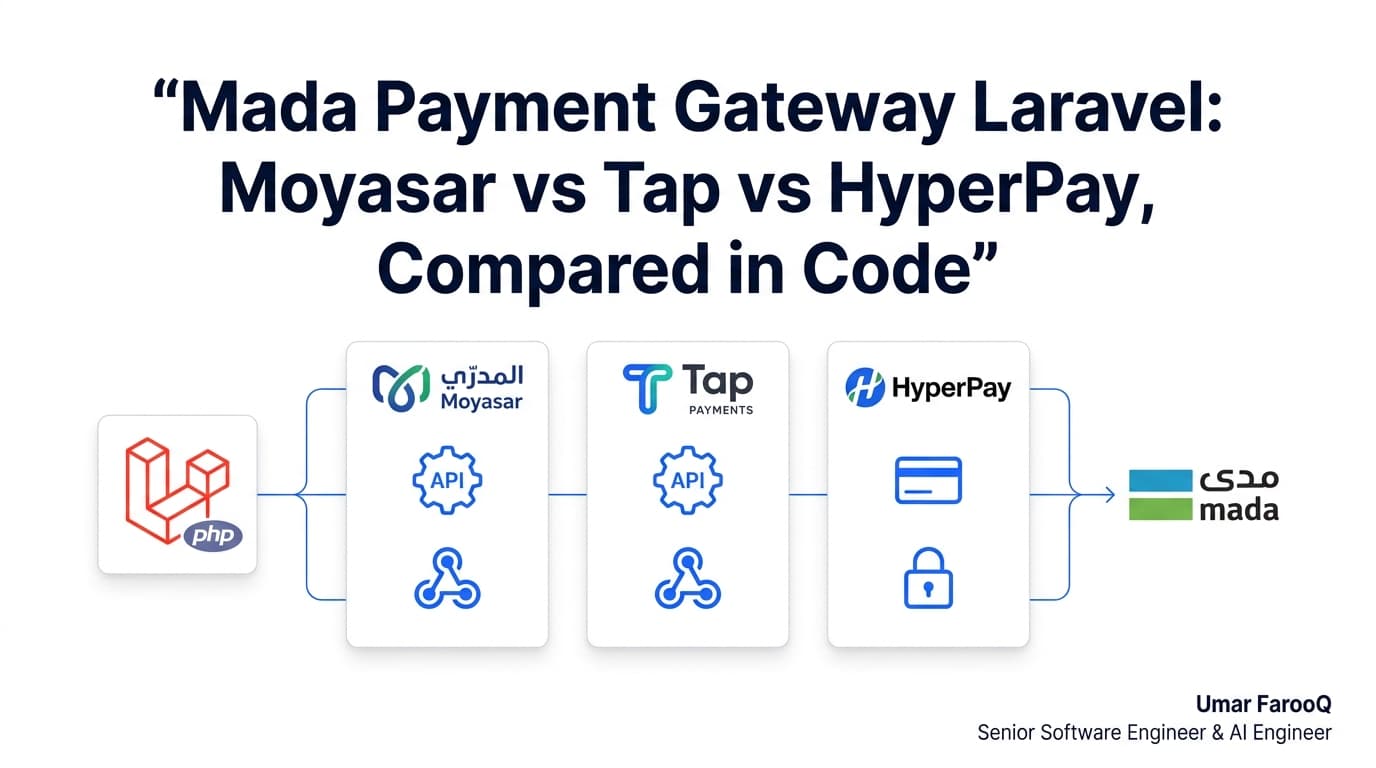
Mada Payment Gateway Laravel: Moyasar vs Tap vs HyperPay, Compared in Code
Every Saudi checkout must accept Mada, and a mada payment gateway laravel integration is where payment projects succeed or quietly bleed money. Stripe is not the default here. The three gateways Saudi engineering teams actually implement are Moyasar, Tap Payments, and HyperPay, and they differ far more in developer experience than in feature lists. I have implemented all three in Laravel applications, and this is the code-first comparison I wish existed before I started.
Quick Answer: For Mada payments in Laravel, Moyasar offers the simplest integration with a clean PHP SDK and fast sandbox setup, Tap provides the most complete API with strong webhook tooling across the GCC, and HyperPay suits high-volume merchants who need its hosted checkout widget. All three support Mada, Apple Pay, and Visa/Mastercard. Choose by integration effort and webhook reliability, not by marketing pages.
How Mada Actually Flows Through These Gateways
Mada is Saudi Arabia's national debit scheme, and none of these gateways talk to it directly from your code. Your Laravel app talks to the gateway API, the gateway routes the Mada transaction. The practical differences show up in three places: how you create the payment, how you confirm it via webhooks, and how you verify those webhooks are genuine. Get webhook verification wrong and you will mark orders as paid that never were. I treat webhook signature verification as the single most important line of code in any payment integration.
Implementation aspect | Moyasar | Tap Payments | HyperPay |
|---|---|---|---|
PHP/Laravel SDK | Official SDK, clean API | REST-first, community wrappers | Hosted widget + server API |
Webhook signature verification | HMAC signature documented | Signature header, well documented | Checksum validation per docs |
Mada support | Native | Native | Native via entity config |
Apple Pay | Supported | Supported | Supported |
Sandbox quality | Fast setup, realistic | Excellent, mirrors production | Functional but slower |
Best fit | Teams that want the shortest path | GCC-wide operations | High-volume enterprise |
Creating the Payment: Three Styles
Moyasar is the most Laravel-friendly. The official SDK means your checkout code stays small:
<?php

namespace App\Services\Payments;

use Moyasar\Moyasar;

class MoyasarPaymentService
{
    public function createPayment(array $order): array
    {
        // Amounts are in the smallest currency unit: halalas for SAR.
        $payment = Moyasar::create([
            'amount' => (int) round($order['total'] * 100),
            'currency' => 'SAR',
            'description' => "Order #{$order['id']}",
            'callback_url' => route('payments.callback'),
            'source' => [
                'type' => 'creditcard',
                'name' => $order['cardholder'],
                'number' => $order['card_number'],
                'cvc' => $order['cvc'],
                'month' => $order['exp_month'],
                'year' => $order['exp_year'],
            ],
        ]);

        // Persist the gateway payment id BEFORE redirecting the customer.
        // If the redirect fails, you can still reconcile by this id.
        $order['model']->update(['gateway_payment_id' => $payment->id]);

        return ['redirect_url' => $payment->source['transaction_url']];
    }
}
Tap is REST-first, which I prefer for larger systems because every step is explicit and debuggable. HyperPay leans on its hosted COPYandPAY widget, which reduces your PCI surface but gives you less control over the checkout UX. For a Saudi startup that needs Mada plus Apple Pay live this week, Moyasar's SDK usually wins on speed. For a business operating across the GCC with one integration, Tap's broader regional coverage justifies the extra code.
Webhooks: Where Integrations Actually Break
The charge creation is the easy part. The hard part is the tap payments webhook handler and its equivalents, because this is where money meets your database. Three rules I follow on every gateway:
<?php

namespace App\Http\Controllers;

use App\Models\Order;
use Illuminate\Http\Request;
use Illuminate\Support\Facades\Log;

class PaymentWebhookController extends Controller
{
    public function handle(Request $request)
    {
        // 1. Verify the signature FIRST, before touching the database.
        //    Each gateway documents its own HMAC scheme; implement it
        //    exactly, including header name and payload ordering.
        if (! $this->signatureIsValid($request)) {
            Log::warning('Rejected payment webhook: bad signature');
            return response()->json(['ok' => false], 401);
        }

        // 2. Idempotency: gateways retry webhooks, sometimes for days.
        $order = Order::where('gateway_payment_id', $request->input('id'))->firstOrFail();
        if ($order->isPaid()) {
            return response()->json(['ok' => true]); // already handled
        }

        // 3. Never trust the webhook amount alone: reconcile against
        //    your own order total before marking anything paid.
        if ((int) $request->input('amount') !== (int) round($order->total * 100)) {
            Log::error('Webhook amount mismatch', ['order' => $order->id]);
            return response()->json(['ok' => false], 422);
        }

        $order->markAsPaid($request->input('id'));

        return response()->json(['ok' => true]);
    }

    protected function signatureIsValid(Request $request): bool
    {
        // Per-gateway HMAC verification against your webhook secret.
        return true; // replace with the gateway's documented scheme
    }
}
The hyperpay mada flow adds one quirk: entity IDs per payment brand are configured server-side, so your code must map the customer's selected brand to the right entity before creating the checkout. Miss that mapping and Mada transactions fail while Visa works, which is a confusing bug to chase at midnight.
Beyond Cards: Tabby, Tamara, and Apple Pay
Saudi checkout is not complete with cards alone. Tabby tamara checkout (buy-now-pay-later) materially affects conversion for higher-ticket stores, and Apple Pay is expected on mobile. Moyasar and Tap both expose these through the same payment-creation flow with a different source type, so architect your PaymentService interface around source types from day one rather than hardcoding card fields. When the business later asks for BNPL, it becomes a configuration change, not a rewrite.
Which gateway should a Saudi startup pick?
If you need Mada live fast with minimal code, Moyasar. Its SDK and sandbox get a Laravel team to production checkout quickest.
Which gateway suits GCC-wide operations?
Tap Payments. One integration covers Saudi Mada plus UAE, Kuwait, and Qatar acquiring, which matters the moment you expand beyond the Kingdom.
How do I test Mada without real cards?
All three gateways provide test card numbers including Mada test PANs in their sandboxes. Run your full webhook cycle, including signature verification and idempotency, against the sandbox before going live.
Should webhooks or polling confirm payments?
Webhooks, always, with a reconciliation job as backup. Polling the gateway on a schedule misses real-time failures; a nightly reconciliation job that compares your unpaid orders against gateway records catches whatever webhooks missed.
Summary & Production Takeaways
A mada payment gateway laravel integration succeeds on webhook discipline, not on which logo you pick. Verify signatures before touching the database, guard every handler with idempotency, reconcile amounts against your own orders, and keep a nightly reconciliation job as backup. Moyasar wins on speed, Tap on regional breadth, HyperPay on enterprise volume. If you want this implemented or audited, book a system architecture call, learn about hiring a Laravel developer in Saudi Arabia, or read my ZATCA Phase 2 Laravel integration guide.

Umar Farooq
Author & ConsultantSpecializes in Laravel, Next.js, and AI products. 5+ years enterprise experience with 80+ delivered platforms and full source code ownership.
Related Engineering Insights
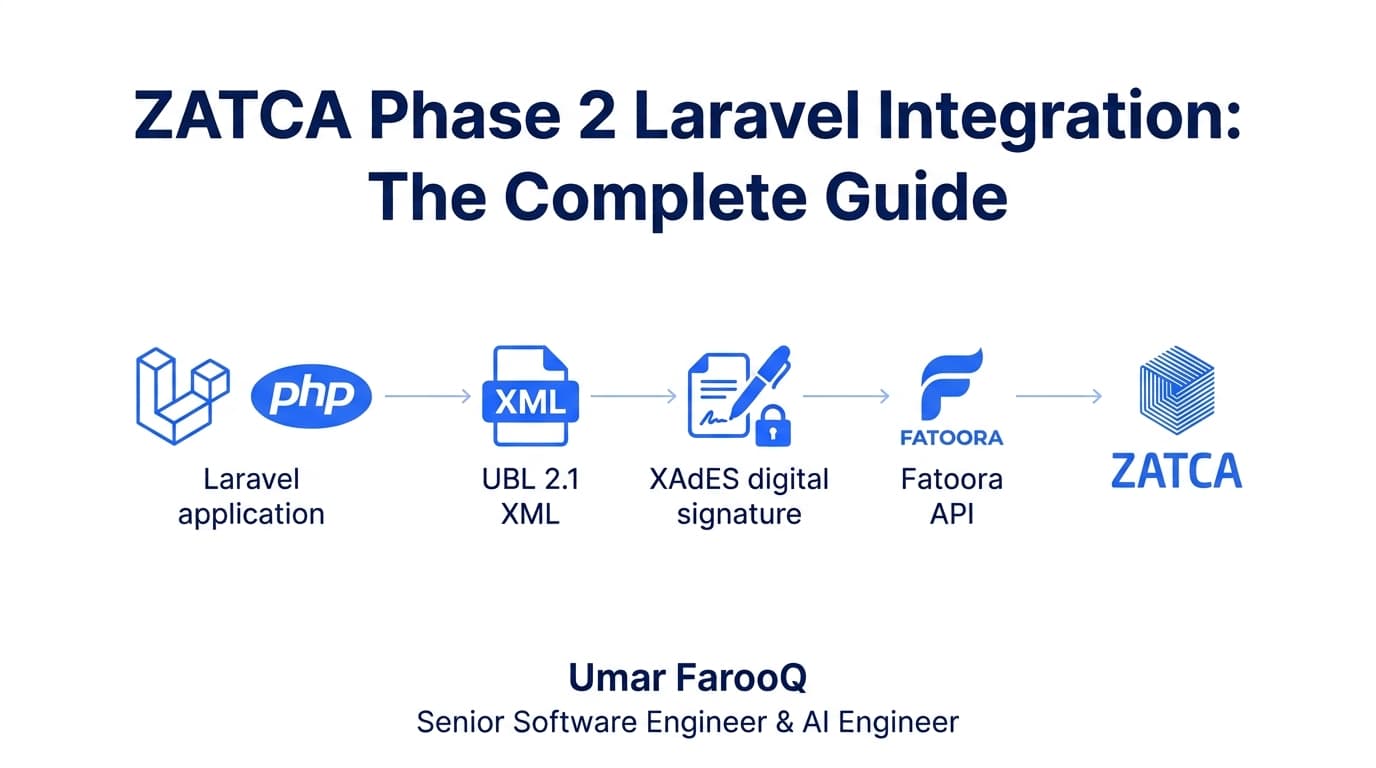
ZATCA Phase 2 Laravel Integration Guide
Master ZATCA Phase 2 e-invoicing in Laravel: clearance vs reporting, CSID onboarding, XAdES signing, and queue-based Fatoora API submission with production code.
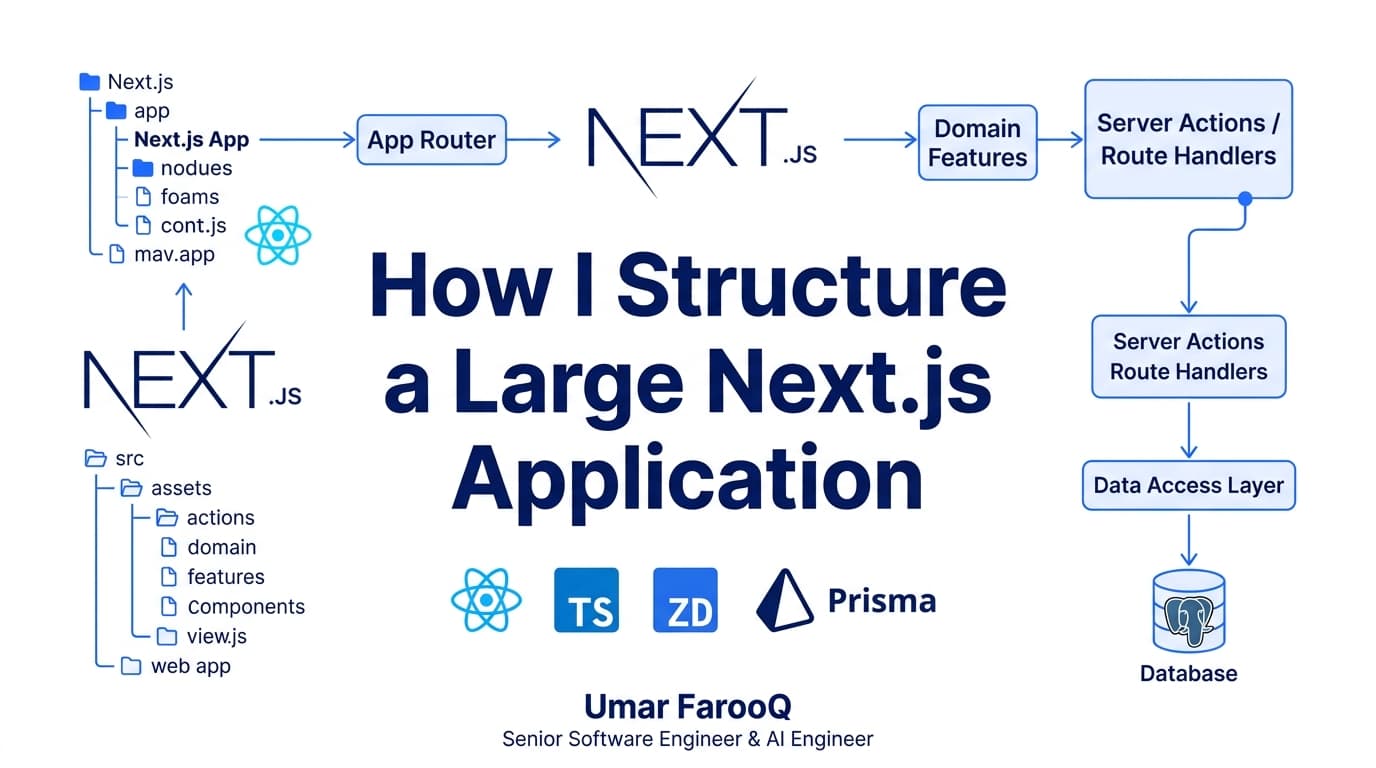
How I Structure a Large Next.js Application
As Next.js applications grow beyond a few pages, messy folder structures create circular dependencies and bloated client bundles. Here is my scalable enterprise architecture.
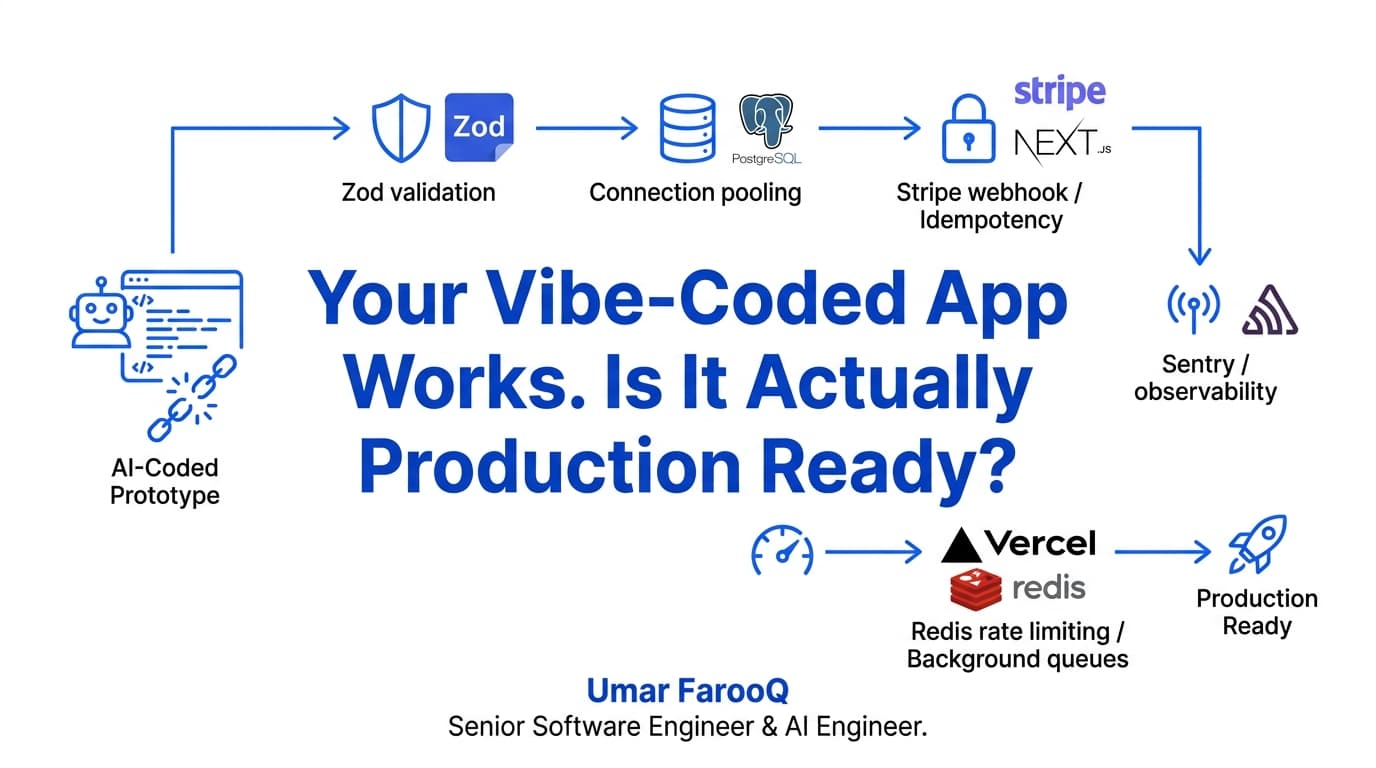
Your Vibe-Coded App Works. Is It Actually Production Ready?
Getting an AI-generated app to run on localhost is easy. Making it survive concurrent traffic, SQL injections, and billing webhooks is where real engineering begins.