RAG vs Fine-Tuning: Which Should You Use?
Should you fine-tune an open-source LLM or build a vector RAG pipeline? Here is a practical engineering guide to cost, hallucination control, and real business requirements.
Umar Farooq
System Architect & Full-Stack Engineer
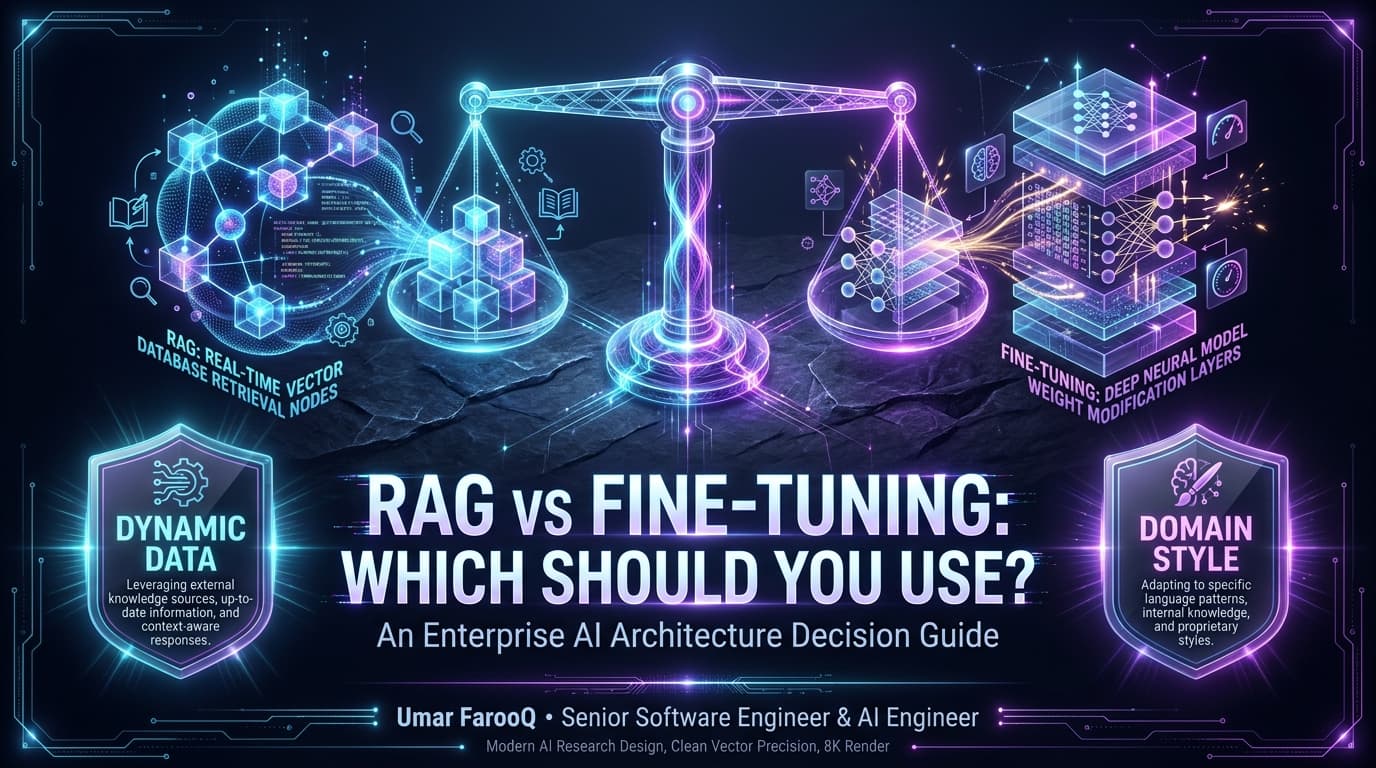
When business leaders and technical founders decide to incorporate generative artificial intelligence into their products, they almost always ask the same initial question: "Should we fine-tune a custom model on our company data, or should we build a Retrieval-Augmented Generation (RAG) system?" Misunderstanding the distinction between these two approaches can cost companies tens of thousands of dollars in wasted compute resources and months of stalled engineering progress.
Having architected AI products and vector pipelines across startup and enterprise environments—including our work at Homeify AI—I have seen that nine out of ten business requirements that teams assume require fine-tuning are actually solved faster, cheaper, and more reliably using RAG.
Think of fine-tuning as training an engineer to adopt a specific communication style, while RAG is handing that engineer an open textbook containing the exact factual answers for today's exam.
Understanding Retrieval-Augmented Generation (RAG)
Retrieval-Augmented Generation connects a foundational language model to an external database containing your proprietary business information. When a user submits a query, the system performs a mathematical similarity search across vector embeddings, retrieves the most relevant paragraphs from your private documents, and injects those facts directly into the model's prompt.
The primary advantages of RAG include:
Near-Zero Hallucination: The model is instructed to answer strictly using the provided context and cite specific document IDs or page numbers.
Instant Data Updates: When an internal company policy or inventory price changes, you simply update the row in your vector database. There is zero retraining delay.
Strict Access Control: You can easily filter database queries based on user permissions, ensuring that junior staff cannot query executive compensation documents.
Production Vector Query Example with PostgreSQL & PgVector
Below is a clean implementation of a semantic cosine similarity search query using PostgreSQL's native PgVector extension paired with Python and FastAPI:
import asyncpg
from typing import List, Dict

async def retrieve_relevant_context(
    query_embedding: List[float],
    organization_id: str,
    match_threshold: float = 0.75,
    match_count: int = 4
) -> List[Dict]:
    """
    Performs cosine distance similarity search over verified document chunks.
    Requires: CREATE EXTENSION IF NOT EXISTS vector;
    """
    conn = await asyncpg.connect("postgresql://user:pass@localhost:5432/production_db")
    try:
        # Enforce multi-tenant isolation and similarity threshold
        query = """
            SELECT
                id,
                document_title,
                content,
                1 - (embedding <=> $1::vector) AS similarity
            FROM document_embeddings
            WHERE organization_id = $2
              AND 1 - (embedding <=> $1::vector) > $3
            ORDER BY embedding <=> $1::vector ASC
            LIMIT $4;
        """
        records = await conn.fetch(
            query,
            str(query_embedding),
            organization_id,
            match_threshold,
            match_count
        )
        return [dict(r) for r in records]
    finally:
        await conn.close()
When Fine-Tuning is Actually Justified
Fine-tuning involves taking a pre-trained model and running additional training passes over thousands of paired examples to adjust the model's internal neural weights. Research papers from ArXiv AI Research and guidelines from Hugging Face Models emphasize that fine-tuning is designed to modify behavior, tone, and formatting—not to inject dynamic real-time knowledge.
Fine-tuning is the correct choice when:
Specialized Output Syntax: You need the model to output a custom DSL (domain-specific language) or proprietary code format that foundational models cannot generate consistently.
Extreme Prompt Latency Constraints: You want to eliminate 2,000 tokens of system prompt instructions on every single request to cut API latency from 800ms down to 150ms.
Domain-Specific Jargon Adaptation: You are parsing highly technical medical diagnostics or complex legal case law where standard vocabulary distributions fail.
Comprehensive Decision Matrix: RAG vs Fine-Tuning
Use this comparison matrix to evaluate your product requirements against commercial constraints:
Decision Factor | Retrieval-Augmented Generation (RAG) | Model Fine-Tuning |
|---|---|---|
Primary Purpose | Factual accuracy and dynamic knowledge retrieval | Style, syntax, and behavioral specialization |
Implementation Timeline | 2 to 4 weeks for complete production pipeline | 2 to 4 months for dataset curation and evaluation |
Data Freshness | Instant (real-time vector insert / delete) | Static (requires re-running training jobs) |
Hallucination Risk | Very low (anchored to verified source text) | Moderate to high without separate retrieval verification |
Permission Filtering | Trivial (filter by tenant or user role in SQL) | Impossible (weights cannot easily hide data by role) |
Upfront Compute Cost | Low (standard vector database storage) | High (GPU cluster training and validation runs) |
The Modern Standard: The Hybrid Architecture
The most sophisticated AI systems in production today do not choose between RAG and fine-tuning. They combine both. They fine-tune a smaller open-source model (such as Llama 3 or Mistral) to specialize in concise, structured output, and then feed that fine-tuned model live real-time context using a high-speed RAG vector pipeline.
This hybrid setup dramatically cuts API token expenditures while ensuring that the business never serves outdated information to its users.
Summary and Strategic Recommendations
Frequently Asked Questions
Is RAG cheaper than model fine-tuning?
Yes, in almost all production use cases. RAG leverages existing pre-trained models and stores your knowledge in cost-effective vector databases like pgvector. Fine-tuning requires expensive GPU compute cycles, curated training datasets, and recurring retraining whenever your underlying business data or product inventory updates.
Does fine-tuning stop AI hallucinations?
No. Fine-tuning teaches a model style, tone, and formatting conventions, but does not reliably inject factual knowledge. In fact, fine-tuned models can hallucinate incorrect facts with high linguistic confidence. RAG grounds responses in verifiable retrieved documents, dramatically reducing hallucinations in enterprise environments.
When is fine-tuning actually necessary?
Fine-tuning is necessary when you need a smaller, specialized model to master a proprietary syntax, domain dialect, or strict structured output format (like specialized medical coding or esoteric JSON schemas), where general prompting or few-shot examples consume too much context window.
Unless you have verified proof that standard prompt engineering and RAG cannot achieve your required output format, always begin with a Retrieval-Augmented Generation architecture. It delivers immediate value, keeps your data fresh, and prevents expensive training iterations.
In our AI applications and autonomous mobile development services, we engineer enterprise RAG systems with 99.4% accuracy, sub-50ms vector query latencies, and up to 80% token cost reduction via intelligent semantic caching.
To review my enterprise track record and verified credentials from Vanderbilt and IBM, visit my About Me page or explore additional engineering articles on the Technical Blog Archive.
Need guidance choosing the right AI architecture or building an autonomous knowledge pipeline for your team? Book an engineering consultation through our Connect page.

Umar Farooq
Author & ConsultantSpecializes in Laravel, Next.js, and AI products. 5+ years enterprise experience with 80+ delivered platforms and full source code ownership.
Related Engineering Insights
Next.js Server Components vs Client Components
Confused about where to draw the 'use client' line in Next.js? Here is a field-tested breakdown of Server vs Client components for sub-second page loads.

Laravel AI SDK: What Can You Actually Build?
Most AI tutorials stop at simple prompt completions. Here is what happens when you combine Laravel queues, database transactions, and modern AI SDKs to build real business software.

How to Automate Complex Business Workflows Using Next.js, Laravel, and AI Agents
Combine the speed of Next.js with the transactional power of Laravel and AI agents to automate complex business tasks with zero headaches.