Do You Still Need a Vector Database? Rethinking RAG in 2026
The debate over agentic RAG vs traditional RAG is really a debate about who does the retrieving: a fixed pipeline or an agent with tools. I stage both architectures, compare them side by side, and take a clear stand on when you still need a vector database.
Umar Farooq
System Architect & Full-Stack Engineer
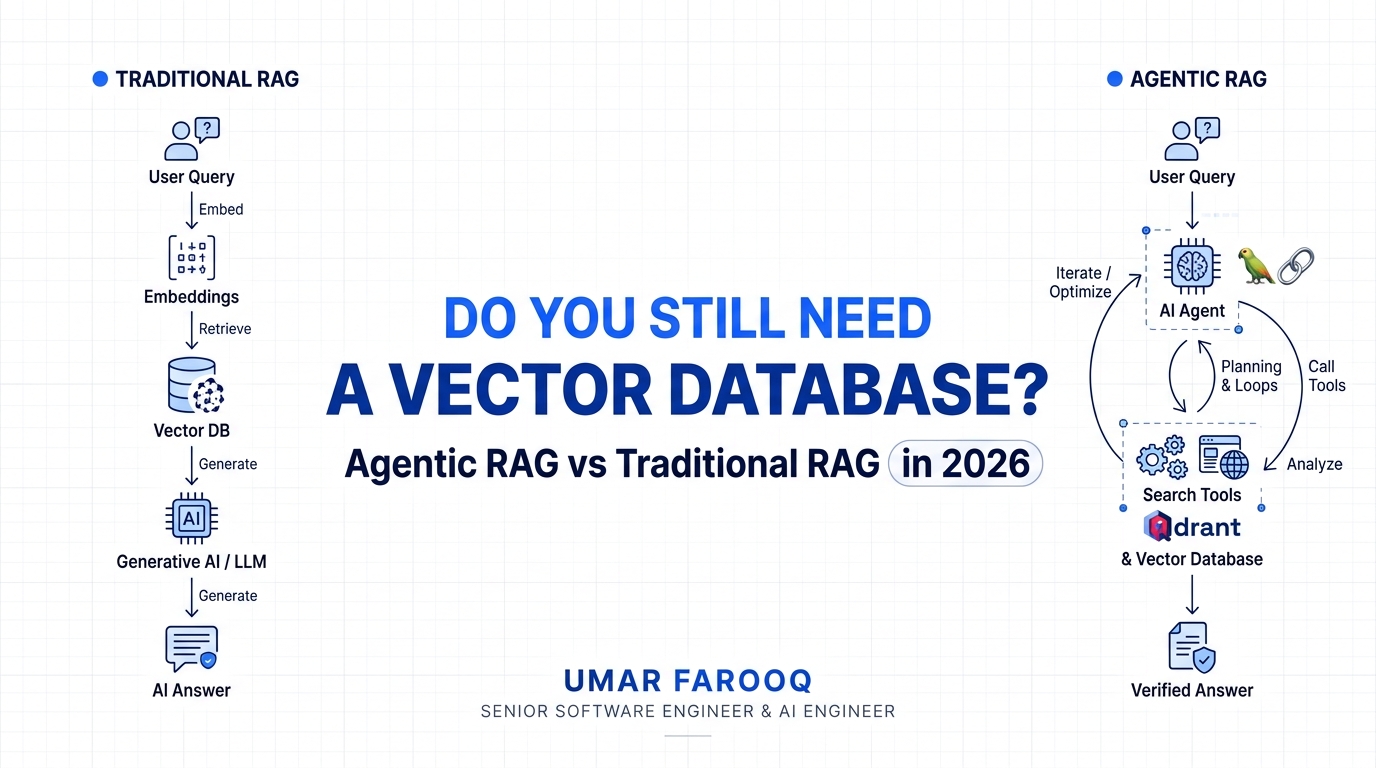
Do You Still Need a Vector Database? Agentic RAG vs Traditional RAG in 2026
Last year, a distribution client in Riyadh asked me for one thing. They wanted an assistant that could answer questions over their internal policy documents. Staff kept asking the same HR questions, and the answers lived in Word files nobody could search. I had to make a call early. Wire up a classic vector pipeline, or hand the searching to an agent? That choice is the agentic RAG vs traditional RAG debate. I had to settle it with a real project, not a blog post.
Quick Answer: Traditional RAG is a fixed pipeline. Embed the question. Search a vector database for the closest chunks. Generate an answer. Agentic RAG hands retrieval to an agent. The agent rewrites the question, calls search tools in a loop, and checks its own evidence. For plain lookups, traditional RAG is cheaper and faster. For messy, multi-step questions, the agent wins. The vector database still wins on large collections where meaning-based search matters.
The Project That Forced the Choice
Context: the client had three versions of their policy documents, one per year. Each version was a stack of Word files. Staff asked questions like "how many annual leave days do I get." The right answer depended on which version applied to them.
Action: I first wired a classic chunk-and-embed pipeline, and simple lookups worked. Then a user asked a question that needed facts from three policy versions at once. One-shot retrieval kept returning the wrong version's chunk. The old document's wording happened to match the question best, so the pipeline returned old rules with full confidence.
I rebuilt it so an agent could search each version separately and compare the results. The agent called a search tool once per year. It read all three answers and picked the facts that matched the user's case.
Result: version-sensitive questions started getting correct answers. No more old rules served as current truth.
Lesson: the vector index was never the problem. The fixed, single-shot pipeline was. That project changed how I see it. Agentic RAG vs traditional RAG is a choice about control, not about which tool is newer.
Traditional RAG, in Plain Words
RAG stands for Retrieval-Augmented Generation. Before the model answers, you fetch relevant text from your own documents and put it in the prompt. That is the whole idea.
A traditional RAG pipeline has four fixed steps. First, split documents into chunks. Second, convert each chunk into an embedding. An embedding is a list of numbers that captures the chunk's meaning. Third, store those embeddings in a vector database. Fourth, at question time, embed the question, pull the closest chunks, and hand them to the model.
Chunk size is its own trade-off. Big chunks carry context but bury the answer. Small chunks are precise but lose meaning. There is no perfect size. Tables and structured documents split badly either way.
This works well for one kind of question: "find the passage that answers this." My RAG versus fine-tuning comparison covers when RAG is the right fit. The weakness is real though. The pipeline retrieves once, with your original wording, and trusts whatever comes back. It never thinks.
Agentic RAG, in Plain Words
Agentic RAG gives the agent retrieval tools instead of a fixed pipeline. The agent decides when to search. It rewrites your question into better search queries. It reads what comes back. It searches again if the evidence is thin. Retrieval becomes a loop, not a single step.
The "is RAG dead" debate caught fire when top coding-agent builders quietly stopped using vector databases. Boris Cherny created Claude Code. On the Latent Space podcast in May 2025, he said early versions used RAG with a local vector database. Agentic search worked better, he said.
Anthropic then named the pattern: just-in-time context loading. The agent keeps light references, like file paths. It loads data into context at runtime using tools. Nothing gets pre-processed into embeddings. Their guidance is blunt. Start with agentic search. Only add semantic search if you need it. This account of the agentic search stack has the full story of the move.
This also kills the stale-index problem. When a document changes, there is no index to rebuild. The agent reads the current file. Traditional RAG needs a re-embed and re-index step, or it answers from old chunks.
Agentic RAG vs Traditional RAG on Cost and Effort
Now the honest weighing, without hype from either camp. On effort, traditional RAG asks more of you up front. You build the chunking, the embedding pipeline, the vector index, and the refresh logic for when documents change. That is real engineering work before the first question is answered.
The agent route asks less up front. Point the agent at your documents through tools and let it figure out the searching. But it asks more of you later, in testing and guardrails. A loop can surprise you.
On money, traditional RAG wins per question. One embedding call, one vector search, one generation. The token bill stays small and predictable. Agentic RAG burns more tokens per question. Every loop turn is another model call. A hard question can take five or six turns. For a demo, nobody notices. For a thousand questions a day, the bill notices.
On latency, the same split holds. Traditional RAG answers in one round trip. The agent answers after several tool calls, each adding seconds. If your user is waiting in a chat window, that wait matters.
On upkeep, the agent has an edge. Documents change. A vector index must be rebuilt or it goes stale. The agent just reads the new file. But the agent needs watching: logs, step caps, and alerts for runaway loops.
Where each shines and fails is the real decision. Traditional RAG shines on simple lookups over one knowledge base: a help center, a product manual, a FAQ. It fails the moment the question needs judgment. Comparing versions, combining facts from three places, deciding which source to trust: all of these break the one-shot pipeline.
Agentic RAG shines on those messy questions. It fails on cost control and predictability. An agent with no step cap can loop, retry, and re-read until a simple question costs real money. That is also why I keep the vector database. It becomes one tool the agent can call, instead of being thrown away.
Where Vector Search Still Wins
Here is where I push back on the "RAG is dead" crowd. "Agentic" and "vector" are two separate choices. A vector database is still the right tool when you need meaning-based discovery over a large collection.
A support assistant searching thousands of help articles is the classic case. Users describe problems in their own fuzzy, synonym-heavy words. Keyword search misses those. Vector search finds the article that means the same thing. It works even when the article shares no words with the question. Large text collections are the other case. Fixed-size chunking remains the normal approach there, even though it fits tables and structured documents poorly.
For exact identifiers, do not reach for more embeddings. Order numbers, invoice numbers, and SKU codes want keyword search first. BM25 handles those better than any embedding. The best setups run both: hybrid search, keyword plus vector, merged through a reranker. Exact identifiers favor keyword search. Fuzzy descriptions favor vectors. The reranker over the merged candidates gives you the best of both. This 2026 RAG best-practices research roundup covers the pattern in depth.
I wrote about this shift in my piece on how AI agents are replacing traditional software features. The agent becomes the retriever. The vector database becomes one tool among several.
Agentic RAG vs Traditional RAG: My Verdict
My stand, with conditions. For multi-step, ambiguous, or multi-source questions, start with an agent that has retrieval tools. For large corpora and meaning-based lookups, keep the vector database. Let the agent call it as one tool. For exact identifiers like order numbers, add keyword search before more embeddings.
Hybrid search covers both worlds: keyword plus vector, merged through a reranker. And never ship the agent without a step cap and an escape hatch. Unbounded loops are how a demo becomes a bill.
The debate is really about control. A fixed pipeline is cheap and predictable. An agent with tools handles messy questions at higher cost and latency. If you build in Laravel, read my notes on what you can actually build with the Laravel AI SDK. They show where these patterns fit in real apps.
Frequently Asked Questions
Is RAG dead in 2026?
No. Agents that call retrieval tools are now the common pattern. But vector search remains the right tool for meaning-based discovery over large collections. RAG as "retrieve text, then generate" is alive. RAG as "only a fixed vector pipeline" is dated.
What is agentic RAG?
Agentic RAG means retrieval happens as tools an AI agent calls, not as a fixed step. The agent decides when to retrieve and rewrites the query. It checks whether the result is enough. Then it either keeps searching or answers.
Do AI agents need vector databases?
Not always. Many agents work well with document APIs, SQL, keyword search, or direct file reads. A vector database earns its place when the task needs semantic retrieval across a large collection of unstructured text.
What is just-in-time context loading?
It is Anthropic's name for a pattern. Agents keep light references, like file paths. They load data into context at runtime using tools. This replaces pre-processing everything into embeddings up front.
When should I use hybrid search instead of pure vector search?
Use hybrid search when your data mixes exact identifiers with fuzzy language. Codes and invoice numbers suit keyword search. Paraphrased questions need vector search. A reranker over the merged candidates gives you the best of both.
Can I build RAG without embeddings?
Yes. Keyword search, SQL queries, structured extraction, and direct document reads all count as retrieval. Choose the mechanism that matches how your users ask and how your documents are structured.
Is agentic RAG more expensive than traditional RAG?
Per question, yes. Every loop turn is another model call. A hard question costs several times more than a one-shot pipeline. The trade is cost for quality on messy questions. A step cap keeps the bill from running away.
Should I add a vector database to my existing agent?
Only if the agent needs meaning-based search over a large collection. If your agent already answers well with file reads, SQL, or keyword search, skip the vector database. Add it when users ask fuzzy questions that keyword search keeps missing.
Pick the Retriever, Then the Tools
Start from the question, not the stack. If your users ask simple lookups, a fixed pipeline is cheaper and faster. If they ask messy, multi-step questions, give an agent the retrieval tools and cap the loop. Keep the vector database for large-scale semantic search. Wrap it as a tool the agent can call. Add keyword search for exact identifiers. If you are planning an AI feature, I can help you choose. Talk to me about your project.

Umar Farooq
Author & ConsultantSpecializes in Laravel, Next.js, and AI products. 5+ years enterprise experience with 80+ delivered platforms and full source code ownership.